
For educational purposes only. This page does not provide medical or veterinary advice, diagnosis, or treatment. Always consult a qualified healthcare or veterinary professional before making any health-related decisions.
Anisakis
Anisakis simplex
Size: Visible to naked eye — larvae 20–30 mm; adults up to 60 mm
Common in raw or undercooked fish worldwide; thousands of human cases reported annually, especially in Japan, Scandinavia, and coastal regions
Anisakis is a parasitic nematode (roundworm) found in the flesh of many marine fish and squid. Humans become accidental hosts by eating raw or undercooked seafood — sushi, sashimi, ceviche, and lightly cured fish are common sources. The larvae cannot complete their lifecycle in humans but burrow into the stomach or intestinal wall, causing a painful condition called anisakiasis. Marine mammals such as dolphins and seals are the definitive hosts.
Lifecycle
Adult Anisakis live in the stomachs of marine mammals (seals, dolphins, whales). Eggs pass into the ocean in feces, hatch into larvae, and are eaten by small crustaceans. Fish and squid eat the crustaceans, and the larvae migrate into the fish's muscle tissue. When a marine mammal (or human) eats infected fish, the larvae mature. In humans, the larvae cannot mature and instead burrow into the gut wall.
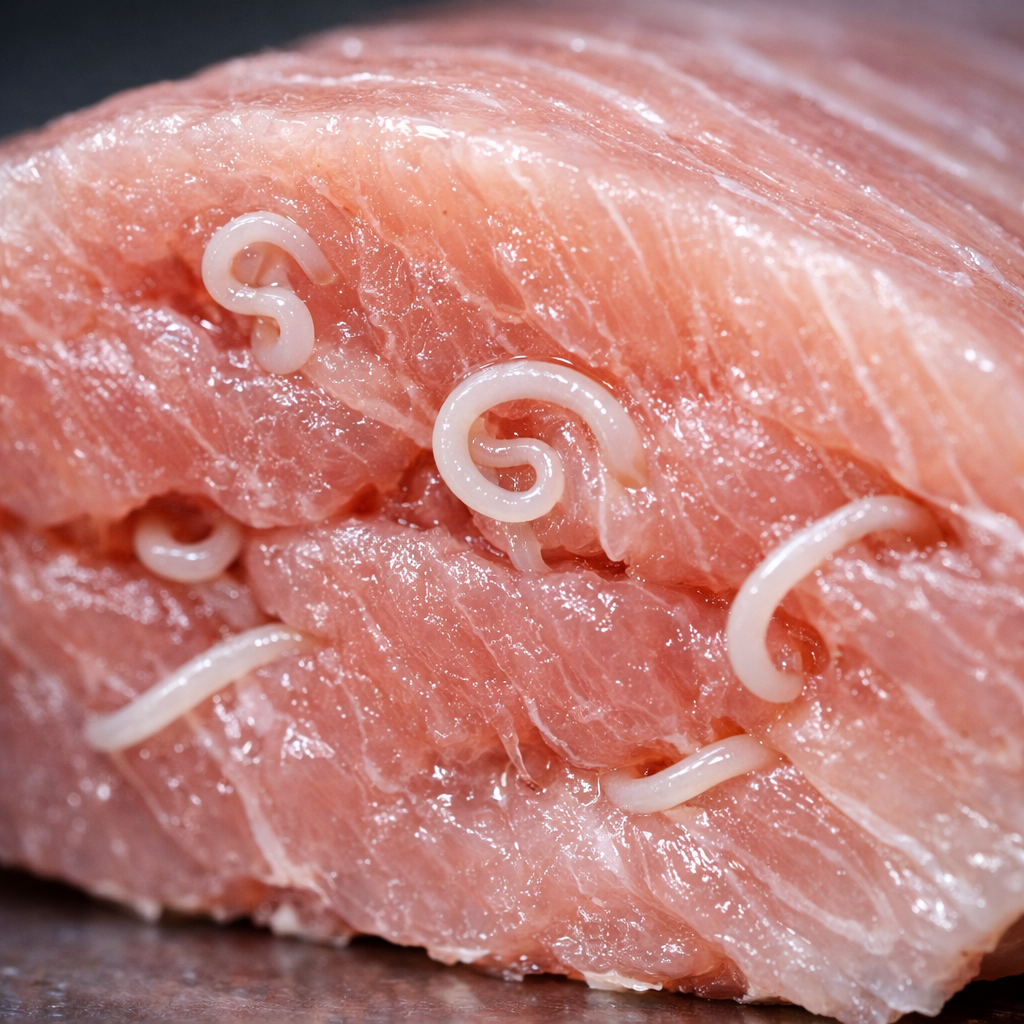
Anisakis — Anisakis simplex
Symptoms
Pharmaceutical treatments
Evidence-based medications used by healthcare and veterinary professionals.
Reference only. Medication names, types, and notes are provided for general awareness. Dosage, suitability, and prescribing decisions must be made by a licensed physician or veterinarian.
Endoscopic removal
Medical procedureThe primary treatment — a gastroenterologist uses an endoscope to locate and physically remove the larvae from the stomach or intestinal wall. Highly effective when performed promptly.
Albendazole
PrescriptionMay be used in cases where endoscopic removal is not possible. Efficacy against Anisakis is limited compared to surgical removal.
Holistic & natural approaches
Traditional, herbal, and integrative approaches for general awareness.
Not a substitute for medical treatment. Natural remedies listed here have not been evaluated by the FDA or equivalent regulatory bodies. Do not use these in place of prescribed treatment. Always consult a qualified healthcare or veterinary professional first.
Prevention: freeze fish before eating raw
Freezing fish at -20°C (-4°F) for at least 7 days (or -35°C for 15 hours) kills Anisakis larvae. This is the most effective non-pharmaceutical prevention measure.
Prevention: thorough cooking
Cooking fish to an internal temperature of 63°C (145°F) kills all Anisakis larvae. Fully cooked fish carries no risk.
Ginger
Traditional Japanese remedy — ginger is often served with sushi. Some laboratory studies suggest gingerols may have activity against Anisakis larvae, though clinical evidence is limited.
Prevention
Zoonotic risk — low or none
Anisakis is not transmitted person-to-person. Humans are accidental dead-end hosts infected through consumption of raw or undercooked marine fish and squid.
Related parasites

Roundworm
Ascaris lumbricoides / Toxocara spp.
Roundworms are large intestinal nematodes and among the most prevalent parasites on Earth. Adult worms live in the small intestine and can reach 15–35 cm in length. Eggs are shed in feces and can survive in soil for years. In pets, Toxocara species are the most common intestinal parasites and can occasionally infect humans (visceral larva migrans).
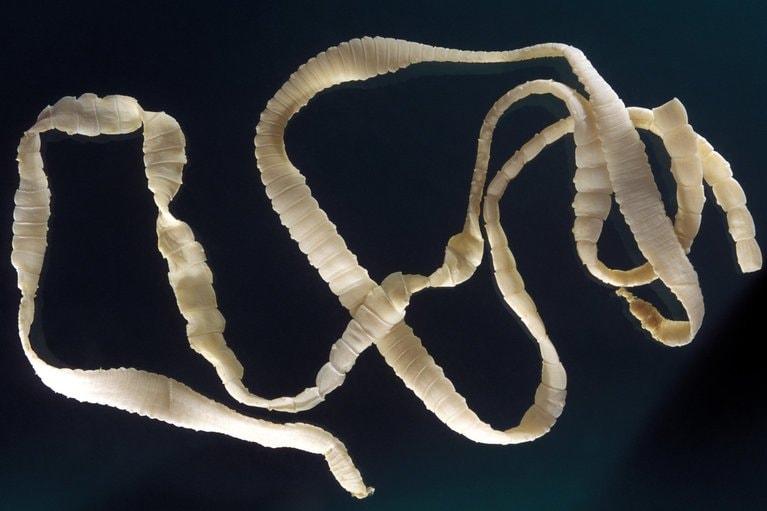
Tapeworm
Taenia spp. / Dipylidium caninum / Echinococcus spp.
Tapeworms are flat, ribbon-like segmented worms that attach to the intestinal wall using suckers and hooks. They have no digestive system and absorb nutrients directly through their skin. Adult worms shed egg-filled segments (proglottids) that look like grains of rice. Some species (Echinococcus) can form dangerous cysts in organs.

Giardia
Giardia duodenalis (syn. G. lamblia, G. intestinalis)
Giardia is a microscopic flagellated protozoan that colonizes the small intestine. It exists in two forms: the active trophozoite (pear-shaped, with two nuclei resembling a face) and the hardy cyst form that can survive in cold water for months. It is a leading cause of waterborne diarrheal illness worldwide.