
For educational purposes only. This page does not provide medical or veterinary advice, diagnosis, or treatment. Always consult a qualified healthcare or veterinary professional before making any health-related decisions.
Blastocystis
Blastocystis hominis / Blastocystis spp.
Size: Microscopic — vacuolar forms 5–40 µm
One of the most common intestinal parasites found in humans — detected in 1–10% of people in developed countries and up to 60% in developing regions
Blastocystis is a microscopic single-celled organism found in the intestines of humans and many animals. Its role as a pathogen is debated — many infected individuals have no symptoms, while others experience significant gastrointestinal distress. It is increasingly linked to irritable bowel syndrome (IBS) and gut microbiome disruption. Multiple subtypes (ST1–ST17) exist, with some more associated with disease than others.
Lifecycle
Blastocystis is transmitted via the fecal-oral route through contaminated water, food, or direct contact with infected feces. Cysts are ingested, excyst in the intestine, and multiply. Vacuolar forms are the most commonly seen in stool. The organism can persist for months in the intestine.

Blastocystis — Blastocystis hominis / Blastocystis spp.
Symptoms
Pharmaceutical treatments
Evidence-based medications used by healthcare and veterinary professionals.
Reference only. Medication names, types, and notes are provided for general awareness. Dosage, suitability, and prescribing decisions must be made by a licensed physician or veterinarian.
Metronidazole
PrescriptionMost commonly prescribed treatment. 500–750 mg three times daily for 5–10 days. Variable efficacy — some strains show resistance.
Trimethoprim-sulfamethoxazole (TMP-SMX)
PrescriptionAlternative treatment, particularly for metronidazole-resistant cases. Used for 7 days.
Nitazoxanide
PrescriptionBroad-spectrum antiparasitic with activity against Blastocystis. 500 mg twice daily for 3 days.
Holistic & natural approaches
Traditional, herbal, and integrative approaches for general awareness.
Not a substitute for medical treatment. Natural remedies listed here have not been evaluated by the FDA or equivalent regulatory bodies. Do not use these in place of prescribed treatment. Always consult a qualified healthcare or veterinary professional first.
Probiotic therapy
Lactobacillus and Saccharomyces boulardii have shown some ability to reduce Blastocystis colonization and improve gut symptoms in studies. May be used alongside or after antiparasitic treatment.
Oregano oil
Carvacrol and thymol in oregano oil have demonstrated antiprotozoal activity in laboratory studies. Used by some integrative practitioners as a supportive measure.
Berberine
Plant alkaloid found in goldenseal and barberry with broad antimicrobial activity. Some evidence of efficacy against intestinal protozoa including Blastocystis.
Low-FODMAP or anti-inflammatory diet
Reducing fermentable carbohydrates may lessen IBS-like symptoms associated with Blastocystis. A gut-supportive diet can improve quality of life while the infection is being addressed.
Prevention
Zoonotic risk — can spread between animals and humans
Blastocystis is found in dogs, cats, and many other animals. Zoonotic transmission is possible — some subtypes found in animals are also found in humans — but the significance of pet-to-human transmission is still being studied. Good hand hygiene after handling pets is recommended.
Related parasites

Roundworm
Ascaris lumbricoides / Toxocara spp.
Roundworms are large intestinal nematodes and among the most prevalent parasites on Earth. Adult worms live in the small intestine and can reach 15–35 cm in length. Eggs are shed in feces and can survive in soil for years. In pets, Toxocara species are the most common intestinal parasites and can occasionally infect humans (visceral larva migrans).
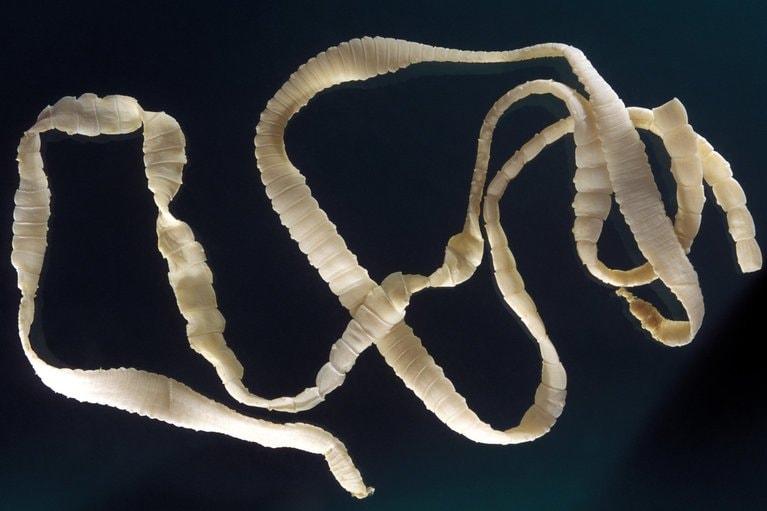
Tapeworm
Taenia spp. / Dipylidium caninum / Echinococcus spp.
Tapeworms are flat, ribbon-like segmented worms that attach to the intestinal wall using suckers and hooks. They have no digestive system and absorb nutrients directly through their skin. Adult worms shed egg-filled segments (proglottids) that look like grains of rice. Some species (Echinococcus) can form dangerous cysts in organs.

Giardia
Giardia duodenalis (syn. G. lamblia, G. intestinalis)
Giardia is a microscopic flagellated protozoan that colonizes the small intestine. It exists in two forms: the active trophozoite (pear-shaped, with two nuclei resembling a face) and the hardy cyst form that can survive in cold water for months. It is a leading cause of waterborne diarrheal illness worldwide.