
For educational purposes only. This page does not provide medical or veterinary advice, diagnosis, or treatment. Always consult a qualified healthcare or veterinary professional before making any health-related decisions.
Chagas Disease
Trypanosoma cruzi
Size: Microscopic — trypomastigotes 15–20 µm
Approximately 6–7 million people infected worldwide; endemic in Latin America; increasing in the United States
Chagas disease is caused by the protozoan parasite Trypanosoma cruzi, transmitted by triatomine bugs (kissing bugs) that defecate near their bite wound. The parasite enters through the bite wound, eyes, or mucous membranes. Chagas has two phases: an acute phase (often mild or asymptomatic) and a chronic phase that can cause severe heart disease and digestive complications decades later. Dogs are important reservoir hosts and can develop cardiac disease similar to humans.
Lifecycle
Infected triatomine bugs (kissing bugs) defecate while feeding. The host inadvertently rubs the infected feces into the bite wound or eyes. Trypomastigotes enter cells, transform into amastigotes, and multiply. They rupture cells, re-enter the bloodstream, and can be taken up by another kissing bug during feeding. Transmission also occurs through blood transfusion, organ transplant, mother-to-child, and contaminated food or drink.

Chagas Disease — Trypanosoma cruzi
Symptoms
Pharmaceutical treatments
Evidence-based medications used by healthcare and veterinary professionals.
Reference only. Medication names, types, and notes are provided for general awareness. Dosage, suitability, and prescribing decisions must be made by a licensed physician or veterinarian.
Benznidazole
PrescriptionFirst-line treatment for Chagas disease. Most effective in the acute phase. FDA-approved for children 2–12 years; used off-label in adults. 60-day course.
Nifurtimox
PrescriptionAlternative antiparasitic drug. FDA-approved for children under 18. Also used in adults when benznidazole is unavailable or not tolerated.
Cardiac medications
PrescriptionAntiarrhythmics, ACE inhibitors, and diuretics for chronic cardiac Chagas. Treat the complications rather than the parasite in the chronic phase.
Holistic & natural approaches
Traditional, herbal, and integrative approaches for general awareness.
Not a substitute for medical treatment. Natural remedies listed here have not been evaluated by the FDA or equivalent regulatory bodies. Do not use these in place of prescribed treatment. Always consult a qualified healthcare or veterinary professional first.
Neem (Azadirachta indica)
Some laboratory studies suggest neem extracts have activity against Trypanosoma species. Used in traditional medicine in endemic regions. Not a substitute for antiparasitic drugs.
Coenzyme Q10
Antioxidant support for cardiac health. Some integrative cardiologists recommend CoQ10 as adjunctive support in Chagas cardiomyopathy. Consult a physician.
Anti-inflammatory diet
Reducing systemic inflammation through diet (omega-3s, antioxidants, reduced processed foods) may support cardiac health in chronic Chagas. Not a treatment for the parasite itself.
Prevention
Zoonotic risk — can spread between animals and humans
Dogs are important reservoir hosts for Trypanosoma cruzi and can harbor the parasite without showing symptoms. Kissing bugs that feed on infected dogs can then transmit the parasite to humans. Direct dog-to-human transmission does not occur — the vector (kissing bug) is required.
Related parasites

Roundworm
Ascaris lumbricoides / Toxocara spp.
Roundworms are large intestinal nematodes and among the most prevalent parasites on Earth. Adult worms live in the small intestine and can reach 15–35 cm in length. Eggs are shed in feces and can survive in soil for years. In pets, Toxocara species are the most common intestinal parasites and can occasionally infect humans (visceral larva migrans).
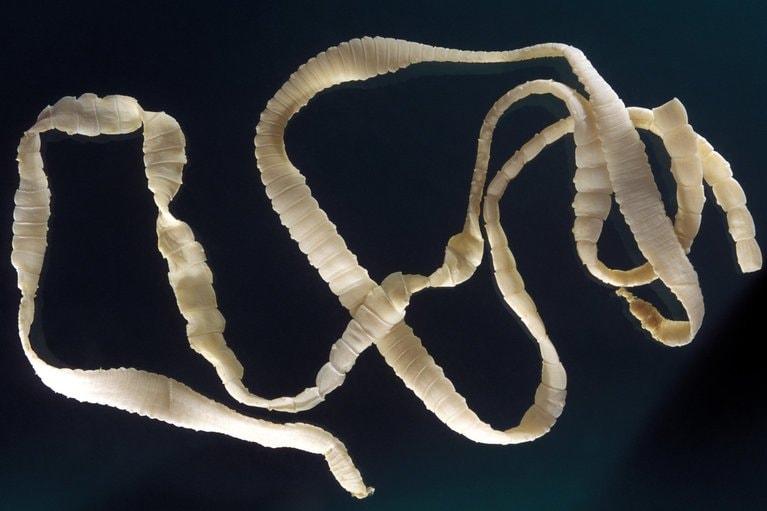
Tapeworm
Taenia spp. / Dipylidium caninum / Echinococcus spp.
Tapeworms are flat, ribbon-like segmented worms that attach to the intestinal wall using suckers and hooks. They have no digestive system and absorb nutrients directly through their skin. Adult worms shed egg-filled segments (proglottids) that look like grains of rice. Some species (Echinococcus) can form dangerous cysts in organs.

Giardia
Giardia duodenalis (syn. G. lamblia, G. intestinalis)
Giardia is a microscopic flagellated protozoan that colonizes the small intestine. It exists in two forms: the active trophozoite (pear-shaped, with two nuclei resembling a face) and the hardy cyst form that can survive in cold water for months. It is a leading cause of waterborne diarrheal illness worldwide.