
For educational purposes only. This page does not provide medical or veterinary advice, diagnosis, or treatment. Always consult a qualified healthcare or veterinary professional before making any health-related decisions.
Marine Ich
Cryptocaryon irritans
Size: Microscopic to barely visible — trophonts 0.4–0.5 mm; visible as white spots on fish
Extremely common in saltwater aquariums worldwide; one of the leading causes of fish death in marine aquarium keeping; also occurs in wild marine fish populations
Cryptocaryon irritans, commonly called marine ich or white spot disease, is a ciliated protozoan parasite that infects the skin, fins, and gills of saltwater fish. It is the marine equivalent of freshwater ich (Ichthyophthirius multifiliis) and is one of the most common and devastating diseases in saltwater aquariums. Infected fish develop characteristic white spots (trophonts) visible on the body and fins. The parasite is highly contagious and can wipe out an entire aquarium if untreated. It does not infect humans.
Lifecycle
The lifecycle has four stages: trophonts (feeding stage embedded in fish skin, visible as white spots), protomonts (leave the fish and settle on substrate), tomonts (divide rapidly in a cyst, producing up to 200 tomites), and theronts (free-swimming infectious stage that must find a host within 24–48 hours or die). The full cycle takes 3–6 weeks at typical aquarium temperatures.
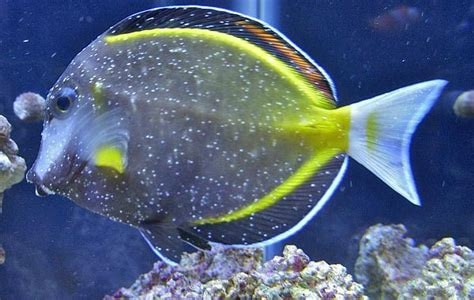
Marine Ich — Cryptocaryon irritans
Symptoms
Pharmaceutical treatments
Evidence-based medications used by healthcare and veterinary professionals.
Reference only. Medication names, types, and notes are provided for general awareness. Dosage, suitability, and prescribing decisions must be made by a licensed physician or veterinarian.
Copper sulfate treatment
Aquarium treatmentThe most effective treatment for marine ich. Maintained at therapeutic levels (0.15–0.20 ppm free copper) for 4 weeks. Toxic to invertebrates — must be used in a fish-only tank or hospital tank.
Chloroquine phosphate
Aquarium treatmentEffective anti-protozoal treatment. Dosed at 40 mg per gallon in a hospital tank for 4 weeks. Less toxic than copper and effective against resistant strains.
Formalin bath
Aquarium treatmentShort-term bath treatment that kills free-swimming theronts and trophonts. Used as a dip or prolonged bath. Requires careful dosing and aeration.
Holistic & natural approaches
Traditional, herbal, and integrative approaches for general awareness.
Not a substitute for medical treatment. Natural remedies listed here have not been evaluated by the FDA or equivalent regulatory bodies. Do not use these in place of prescribed treatment. Always consult a qualified healthcare or veterinary professional first.
Hyposalinity (low salinity treatment)
Reducing specific gravity to 1.009–1.010 for 4–6 weeks stresses and kills the parasite while most marine fish can tolerate it. Cannot be used with invertebrates. Effectiveness is debated — some strains tolerate low salinity.
Tank fallow period
Removing all fish from the display tank for a minimum of 76 days (at 75°F/24°C) starves the parasite — theronts die without a host. The most reliable non-chemical approach. Invertebrates and corals can remain.
UV sterilizer
A properly sized UV sterilizer kills free-swimming theronts as they pass through, reducing the parasite load. Does not eliminate an active infection but helps prevent spread and recurrence.
Garlic extract
Some aquarists report that garlic-soaked food encourages infected fish to eat and may have mild antiparasitic properties. Evidence is anecdotal — not a standalone treatment but may support fish immunity.
Prevention
Zoonotic risk — low or none
Cryptocaryon irritans does not infect humans. It is exclusively a parasite of marine fish and poses no human health risk.
Related parasites
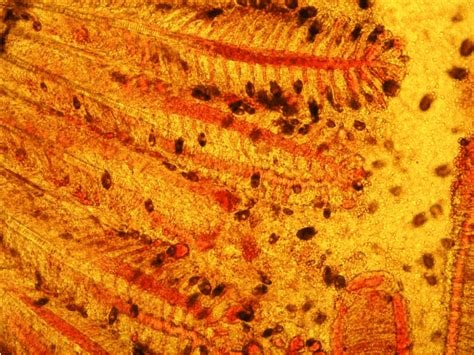
Marine Velvet
Amyloodinium ocellatum
Amyloodinium ocellatum, commonly called marine velvet or coral fish disease, is a parasitic dinoflagellate (a type of single-celled organism related to algae) that infects the skin and gills of saltwater fish. It is considered even more dangerous than marine ich — it spreads faster, is harder to see in early stages, and can kill fish within 24–72 hours of heavy infestation. Infected fish develop a characteristic gold or rust-colored dusty coating (like velvet fabric) on their body and fins. It is one of the leading causes of fish death in marine aquariums.

Neobenedenia
Neobenedenia spp.
Neobenedenia are parasitic flatworms (monogenean flukes) that live on the skin, fins, and eyes of marine fish. They are among the most economically damaging parasites in marine aquaculture, causing massive losses in sea bass, grouper, snapper, and other farmed species. Neobenedenia are hermaphroditic, reproduce rapidly, and can complete their entire lifecycle on a single fish host — making population explosions possible in the confined conditions of fish farms and aquariums. They feed on skin cells and mucus, causing lesions, eye damage (sometimes blindness), and secondary infections.