
For educational purposes only. This page does not provide medical or veterinary advice, diagnosis, or treatment. Always consult a qualified healthcare or veterinary professional before making any health-related decisions.
Cryptosporidium
Cryptosporidium parvum / C. hominis
Size: Microscopic — oocysts 4–6 µm
One of the most common causes of waterborne diarrheal illness worldwide; responsible for ~750,000 cases annually in the US alone
Cryptosporidium is a microscopic protozoan parasite that infects the small intestine, causing cryptosporidiosis — a diarrheal illness that can be severe or life-threatening in immunocompromised individuals. It is transmitted primarily through contaminated water (including treated swimming pools and drinking water) and is highly resistant to standard chlorine disinfection. Young children, the elderly, and people with weakened immune systems are most at risk.
Lifecycle
Oocysts are ingested through contaminated water, food, or contact with infected feces. In the small intestine, sporozoites are released and invade epithelial cells. They reproduce asexually and sexually, producing new oocysts that are shed in feces — sometimes in enormous numbers. Oocysts are immediately infectious upon shedding and can survive in the environment for months.

Cryptosporidium — Cryptosporidium parvum / C. hominis
Symptoms
Pharmaceutical treatments
Evidence-based medications used by healthcare and veterinary professionals.
Reference only. Medication names, types, and notes are provided for general awareness. Dosage, suitability, and prescribing decisions must be made by a licensed physician or veterinarian.
Nitazoxanide (Alinia)
PrescriptionOnly FDA-approved drug specifically for cryptosporidiosis in immunocompetent patients. 500 mg twice daily for 3 days in adults; 100–200 mg twice daily for 3 days in children. Not reliably effective in HIV/AIDS patients.
Oral rehydration therapy (ORT)
OTCPrimary treatment for most cases. Replace fluids and electrolytes lost through diarrhea. Use WHO oral rehydration salts (ORS) or commercial electrolyte solutions. IV fluids may be needed in severe dehydration.
Antiretroviral therapy (ART) — HIV patients
PrescriptionIn HIV-positive patients, restoring immune function with ART is the most effective treatment for chronic cryptosporidiosis. Immune reconstitution often leads to spontaneous resolution.
Paromomycin
PrescriptionNon-absorbable aminoglycoside antibiotic used off-label in immunocompromised patients when nitazoxanide is ineffective. 500–750 mg three times daily for 14–28 days. Partial efficacy only.
Fenbendazole / Metronidazole (veterinary)
Veterinary PrescriptionUsed in dogs and cats with symptomatic cryptosporidiosis. Supportive care and fluid therapy are equally important. Most healthy adult pets clear the infection without treatment.
Holistic & natural approaches
Traditional, herbal, and integrative approaches for general awareness.
Not a substitute for medical treatment. Natural remedies listed here have not been evaluated by the FDA or equivalent regulatory bodies. Do not use these in place of prescribed treatment. Always consult a qualified healthcare or veterinary professional first.
Probiotics (Lactobacillus, Saccharomyces boulardii)
Saccharomyces boulardii has shown modest benefit in reducing diarrhea duration in some studies. Probiotics help restore gut flora disrupted by infection. Use alongside conventional treatment, not as a replacement.
Colostrum (bovine)
Bovine colostrum contains immunoglobulins (IgG) that may bind Cryptosporidium oocysts and reduce intestinal colonization. Some small trials show reduced diarrhea duration. Available as powder or capsules.
Ginger (Zingiber officinale)
Ginger has anti-nausea and mild anti-inflammatory properties that may ease symptoms. Brew as tea or take as capsules. Not antiparasitic but may improve comfort during illness.
Oregano oil
Carvacrol and thymol in oregano oil have demonstrated antiprotozoal activity in laboratory studies. Clinical evidence in humans is lacking. If used, dilute in carrier oil and take with food to avoid GI irritation.
Prevention
Zoonotic risk — can spread between animals and humans
Cryptosporidium parvum is zoonotic and can be transmitted between humans and animals. Calves, lambs, and other young livestock are major reservoir hosts. Dogs and cats can carry Cryptosporidium but are less commonly a source of human infection than livestock or contaminated water.
Related parasites

Roundworm
Ascaris lumbricoides / Toxocara spp.
Roundworms are large intestinal nematodes and among the most prevalent parasites on Earth. Adult worms live in the small intestine and can reach 15–35 cm in length. Eggs are shed in feces and can survive in soil for years. In pets, Toxocara species are the most common intestinal parasites and can occasionally infect humans (visceral larva migrans).
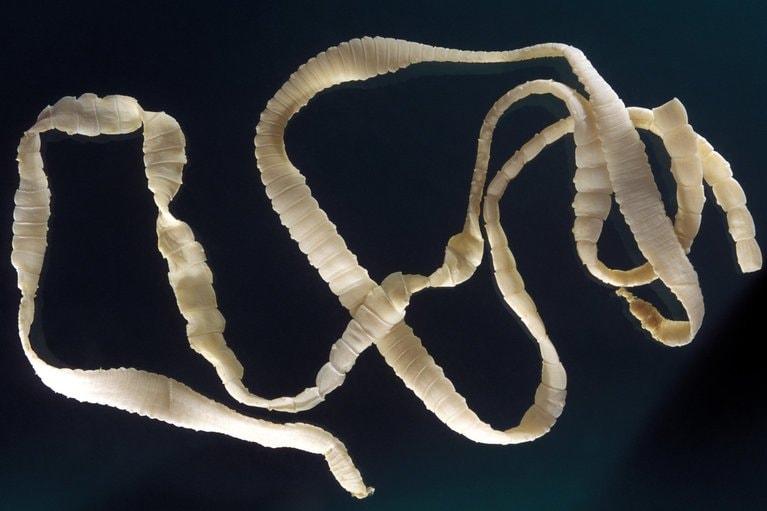
Tapeworm
Taenia spp. / Dipylidium caninum / Echinococcus spp.
Tapeworms are flat, ribbon-like segmented worms that attach to the intestinal wall using suckers and hooks. They have no digestive system and absorb nutrients directly through their skin. Adult worms shed egg-filled segments (proglottids) that look like grains of rice. Some species (Echinococcus) can form dangerous cysts in organs.

Giardia
Giardia duodenalis (syn. G. lamblia, G. intestinalis)
Giardia is a microscopic flagellated protozoan that colonizes the small intestine. It exists in two forms: the active trophozoite (pear-shaped, with two nuclei resembling a face) and the hardy cyst form that can survive in cold water for months. It is a leading cause of waterborne diarrheal illness worldwide.