
For educational purposes only. This page does not provide medical or veterinary advice, diagnosis, or treatment. Always consult a qualified healthcare or veterinary professional before making any health-related decisions.
Demodex Mange
Demodex canis / D. cati / D. folliculorum
Size: Microscopic — adults 0.1–0.4 mm; not visible to naked eye
Demodex mites are present on virtually all adult humans; clinical disease occurs when populations overgrow
Demodex are microscopic cigar-shaped mites that live in hair follicles and sebaceous glands. In small numbers they are considered normal skin flora in humans and most dogs. Demodicosis (demodectic mange) occurs when the immune system fails to keep mite populations in check — most commonly in puppies, elderly dogs, or immunocompromised individuals. Unlike sarcoptic mange, demodectic mange is generally not contagious between animals.
Lifecycle
Demodex mites complete their entire lifecycle on the host — from egg to larva to nymph to adult — within the hair follicle. They feed on sebum and skin cells. Transmission occurs through direct contact, primarily from mother to offspring during nursing. In humans, mites are transmitted through close skin contact.

Demodex Mange — Demodex canis / D. cati / D. folliculorum
Symptoms
Pharmaceutical treatments
Evidence-based medications used by healthcare and veterinary professionals.
Reference only. Medication names, types, and notes are provided for general awareness. Dosage, suitability, and prescribing decisions must be made by a licensed physician or veterinarian.
Isoxazoline class (Bravecto, Nexgard, Simparica)
Veterinary (Prescription)Highly effective oral treatments for canine demodicosis. Monthly or 3-monthly dosing. Now considered first-line treatment.
Ivermectin (oral)
Veterinary (Prescription)Daily oral ivermectin for 60–120 days. Effective but requires careful dosing. Contraindicated in MDR1/ABCB1 mutation breeds (Collies, Shelties, Australian Shepherds).
Amitraz dips
Veterinary (Prescription)Topical dip applied every 1–2 weeks. Effective but requires careful handling — toxic to cats and humans.
Ivermectin / permethrin cream (human)
PrescriptionTopical treatments for human Demodex-associated rosacea and blepharitis. Ivermectin 1% cream (Soolantra) is FDA-approved for rosacea.
Holistic & natural approaches
Traditional, herbal, and integrative approaches for general awareness.
Not a substitute for medical treatment. Natural remedies listed here have not been evaluated by the FDA or equivalent regulatory bodies. Do not use these in place of prescribed treatment. Always consult a qualified healthcare or veterinary professional first.
Tea tree oil (diluted)
Has demonstrated acaricidal activity against Demodex in laboratory studies. Must be diluted to 5% or less — undiluted tea tree oil is toxic to dogs and cats. Used in some human eyelid scrubs for blepharitis.
Coconut oil
Lauric acid in coconut oil has mild antimicrobial properties. Some pet owners apply topically to affected areas. Evidence is anecdotal.
Immune-supportive diet
Since demodicosis is often linked to immune suppression, a high-quality diet with omega-3 fatty acids, zinc, and antioxidants may support immune function and skin health.
Prevention
Zoonotic risk — low or none
Demodex species are host-specific. D. canis (dogs) and D. cati (cats) do not infect humans. Human Demodex species (D. folliculorum and D. brevis) are distinct and are not acquired from pets.
Related parasites

Roundworm
Ascaris lumbricoides / Toxocara spp.
Roundworms are large intestinal nematodes and among the most prevalent parasites on Earth. Adult worms live in the small intestine and can reach 15–35 cm in length. Eggs are shed in feces and can survive in soil for years. In pets, Toxocara species are the most common intestinal parasites and can occasionally infect humans (visceral larva migrans).
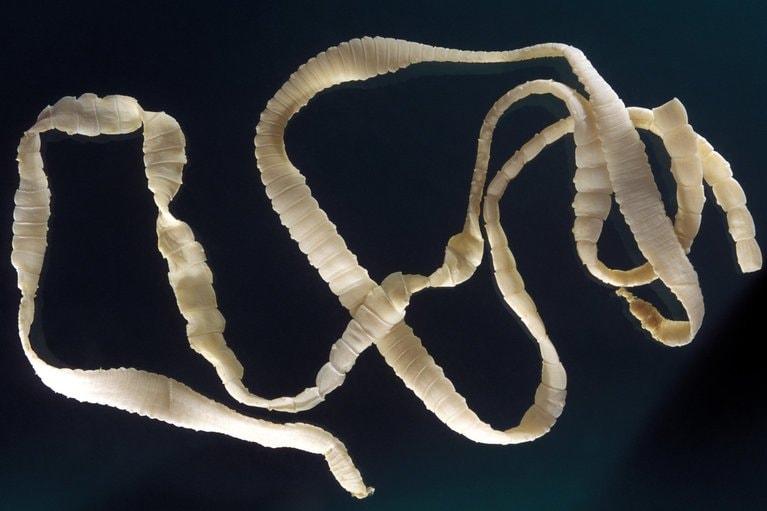
Tapeworm
Taenia spp. / Dipylidium caninum / Echinococcus spp.
Tapeworms are flat, ribbon-like segmented worms that attach to the intestinal wall using suckers and hooks. They have no digestive system and absorb nutrients directly through their skin. Adult worms shed egg-filled segments (proglottids) that look like grains of rice. Some species (Echinococcus) can form dangerous cysts in organs.

Giardia
Giardia duodenalis (syn. G. lamblia, G. intestinalis)
Giardia is a microscopic flagellated protozoan that colonizes the small intestine. It exists in two forms: the active trophozoite (pear-shaped, with two nuclei resembling a face) and the hardy cyst form that can survive in cold water for months. It is a leading cause of waterborne diarrheal illness worldwide.