
For educational purposes only. This page does not provide medical or veterinary advice, diagnosis, or treatment. Always consult a qualified healthcare or veterinary professional before making any health-related decisions.
Flea
Ctenocephalides felis / Ctenocephalides canis
Size: Visible to naked eye — adults 1.5–3.3 mm
Most common external parasite of cats and dogs worldwide; present on every continent except Antarctica
Fleas are wingless, laterally compressed insects that are extraordinary jumpers — they can leap 150 times their own body length. The cat flea (Ctenocephalides felis) infests both cats and dogs. Only 5% of the flea population lives on the pet — 95% (eggs, larvae, pupae) are in the environment. A single female can lay 2,000 eggs in her lifetime.
Lifecycle
Eggs fall off the host into carpets and bedding. Larvae feed on organic debris and adult flea feces. Pupae can remain dormant for months until vibration or heat signals a host is nearby. Adults emerge and immediately seek a blood meal.

Flea — Ctenocephalides felis / Ctenocephalides canis
Symptoms
Pharmaceutical treatments
Evidence-based medications used by healthcare and veterinary professionals.
Reference only. Medication names, types, and notes are provided for general awareness. Dosage, suitability, and prescribing decisions must be made by a licensed physician or veterinarian.
Afoxolaner (NexGard)
PrescriptionOral chewable for dogs. Kills fleas within 8 hours. Monthly dosing.
Fluralaner (Bravecto)
PrescriptionOral or topical. Single dose protects for 3 months (dogs) or 12 weeks (cats).
Selamectin (Revolution)
PrescriptionTopical spot-on for cats and dogs. Also covers heartworm, ear mites, and some ticks.
Imidacloprid (Advantage)
OTC/PrescriptionTopical spot-on. Kills fleas on contact (no bite required). Monthly application.
Nitenpyram (Capstar)
OTCOral tablet that kills adult fleas within 30 minutes. Short-acting (24 hours) — used for rapid knockdown, not prevention.
Holistic & natural approaches
Traditional, herbal, and integrative approaches for general awareness.
Not a substitute for medical treatment. Natural remedies listed here have not been evaluated by the FDA or equivalent regulatory bodies. Do not use these in place of prescribed treatment. Always consult a qualified healthcare or veterinary professional first.
Diatomaceous earth (food grade)
Microscopic fossilized algae that physically damages flea exoskeletons. Apply to carpets, pet bedding, and yard. Leave 48 hours then vacuum. Safe for pets and humans when food-grade.
Cedar oil spray
Natural insect repellent. Spray on pet bedding, carpets, and around the home. Some formulations safe for direct pet application. Avoid use around cats.
Salt
Fine salt dehydrates flea larvae and eggs in carpets. Sprinkle, leave 1–2 days, vacuum thoroughly. Repeat weekly.
Brewer's yeast + garlic (dietary)
Traditionally fed to pets to make skin less attractive to fleas. Evidence is limited but widely used. Caution: garlic can be toxic to cats in large amounts.
Frequent vacuuming
Vacuuming removes up to 96% of flea eggs and larvae from carpets. Vacuum daily during an infestation, dispose of the bag immediately. This is the single most effective non-chemical environmental control.
Prevention
Zoonotic risk — can spread between animals and humans
Fleas bite humans and can transmit murine typhus and, historically, plague (Yersinia pestis). Cat scratch disease (Bartonella henselae) is spread between cats by fleas and can infect humans via cat scratches.
Related parasites

Roundworm
Ascaris lumbricoides / Toxocara spp.
Roundworms are large intestinal nematodes and among the most prevalent parasites on Earth. Adult worms live in the small intestine and can reach 15–35 cm in length. Eggs are shed in feces and can survive in soil for years. In pets, Toxocara species are the most common intestinal parasites and can occasionally infect humans (visceral larva migrans).
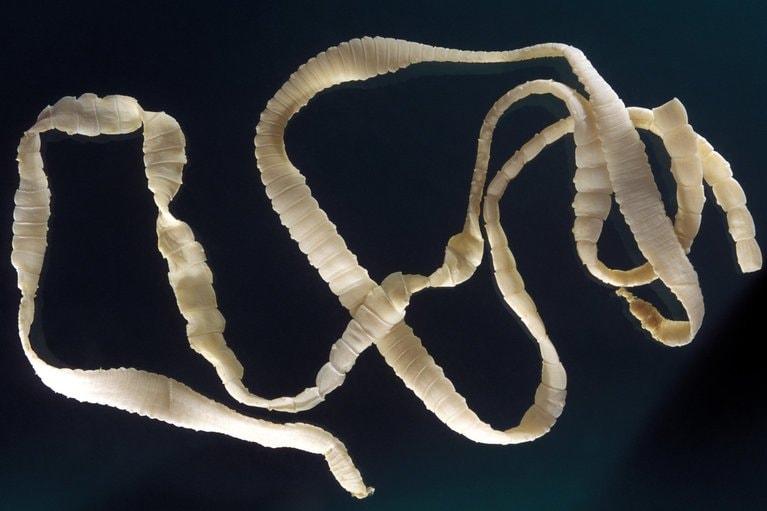
Tapeworm
Taenia spp. / Dipylidium caninum / Echinococcus spp.
Tapeworms are flat, ribbon-like segmented worms that attach to the intestinal wall using suckers and hooks. They have no digestive system and absorb nutrients directly through their skin. Adult worms shed egg-filled segments (proglottids) that look like grains of rice. Some species (Echinococcus) can form dangerous cysts in organs.

Giardia
Giardia duodenalis (syn. G. lamblia, G. intestinalis)
Giardia is a microscopic flagellated protozoan that colonizes the small intestine. It exists in two forms: the active trophozoite (pear-shaped, with two nuclei resembling a face) and the hardy cyst form that can survive in cold water for months. It is a leading cause of waterborne diarrheal illness worldwide.