
For educational purposes only. This page does not provide medical or veterinary advice, diagnosis, or treatment. Always consult a qualified healthcare or veterinary professional before making any health-related decisions.
Heartworm
Dirofilaria immitis
Size: Visible to naked eye — adults 15–30 cm (female); 12–20 cm (male)
Endemic in all 50 US states; highest prevalence along the Gulf Coast and Mississippi River valley
Heartworm is a serious, potentially fatal parasitic disease caused by foot-long worms living in the heart, lungs, and pulmonary arteries. Dogs are the natural host and can harbor hundreds of worms. Cats are atypical hosts — they usually have fewer worms but the disease is often more sudden and severe. Transmitted exclusively by mosquitoes.
Lifecycle
Mosquitoes ingest microfilariae (baby heartworms) from an infected animal's blood. Larvae develop in the mosquito over 10–14 days, then are deposited on the skin when the mosquito feeds. Larvae migrate through tissue, enter the bloodstream, and reach the heart and lungs where they mature over 6 months.

Heartworm — Dirofilaria immitis
Symptoms
Pharmaceutical treatments
Evidence-based medications used by healthcare and veterinary professionals.
Reference only. Medication names, types, and notes are provided for general awareness. Dosage, suitability, and prescribing decisions must be made by a licensed physician or veterinarian.
Melarsomine (Immiticide)
Prescription (dogs only)Arsenic-based adulticide injected into back muscles. Kills adult worms. Requires strict exercise restriction during treatment.
Doxycycline
PrescriptionTargets Wolbachia bacteria that heartworms depend on. Given before adulticide treatment to weaken worms and reduce inflammation.
Prednisone/Prednisolone
PrescriptionAnti-inflammatory steroid used to manage pulmonary inflammation during treatment.
Ivermectin (monthly preventives)
PrescriptionHeartgard, Interceptor, Revolution — monthly preventives that kill larvae before they mature. Essential year-round in endemic areas.
Cats: supportive care only
PrescriptionNo approved adulticide for cats. Treatment involves prednisolone for inflammation and bronchodilators. Many cats survive with management.
Holistic & natural approaches
Traditional, herbal, and integrative approaches for general awareness.
Not a substitute for medical treatment. Natural remedies listed here have not been evaluated by the FDA or equivalent regulatory bodies. Do not use these in place of prescribed treatment. Always consult a qualified healthcare or veterinary professional first.
Slow-kill protocol (controversial)
Monthly ivermectin preventives over 2+ years slowly reduce adult worm burden as worms die naturally. Less effective than melarsomine but used when owners decline standard treatment. Requires veterinary supervision.
Hawthorn berry
Supports cardiovascular function and heart muscle strength. Used as a supportive supplement alongside conventional treatment. Not a replacement for medical care.
CoQ10
Antioxidant that supports heart muscle function. Used as a supportive supplement in dogs with cardiac compromise from heartworm disease.
Exercise restriction
Strict rest is critical during and after treatment. Physical activity increases the risk of worm fragments causing pulmonary embolism. This is non-negotiable.
Prevention
Zoonotic risk — low or none
Heartworm is not transmitted directly between animals or to humans. Rare human cases occur but larvae do not mature in humans.
Related parasites

Roundworm
Ascaris lumbricoides / Toxocara spp.
Roundworms are large intestinal nematodes and among the most prevalent parasites on Earth. Adult worms live in the small intestine and can reach 15–35 cm in length. Eggs are shed in feces and can survive in soil for years. In pets, Toxocara species are the most common intestinal parasites and can occasionally infect humans (visceral larva migrans).
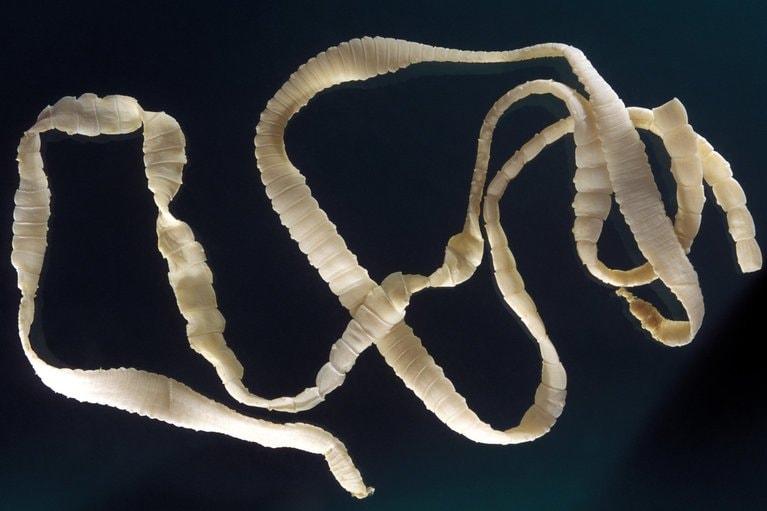
Tapeworm
Taenia spp. / Dipylidium caninum / Echinococcus spp.
Tapeworms are flat, ribbon-like segmented worms that attach to the intestinal wall using suckers and hooks. They have no digestive system and absorb nutrients directly through their skin. Adult worms shed egg-filled segments (proglottids) that look like grains of rice. Some species (Echinococcus) can form dangerous cysts in organs.

Giardia
Giardia duodenalis (syn. G. lamblia, G. intestinalis)
Giardia is a microscopic flagellated protozoan that colonizes the small intestine. It exists in two forms: the active trophozoite (pear-shaped, with two nuclei resembling a face) and the hardy cyst form that can survive in cold water for months. It is a leading cause of waterborne diarrheal illness worldwide.