
For educational purposes only. This page does not provide medical or veterinary advice, diagnosis, or treatment. Always consult a qualified healthcare or veterinary professional before making any health-related decisions.
Hookworm
Ancylostoma duodenale / Necator americanus / Ancylostoma caninum
Size: Visible to naked eye — adults 1–1.5 cm
~700 million people infected worldwide; most common in tropical and subtropical regions
Hookworms are small (1–1.5 cm) but voracious blood-feeders. They attach to the intestinal wall with cutting plates or teeth and feed continuously, secreting anticoagulants to keep blood flowing. A single Ancylostoma duodenale can consume 0.2 mL of blood per day. Heavy infections cause severe iron-deficiency anemia, particularly dangerous in puppies, kittens, and children.
Lifecycle
Eggs hatch in warm, moist soil. Infective larvae (L3) penetrate bare skin (causing ground itch) or are ingested. Larvae migrate through the bloodstream to the lungs, are coughed up and swallowed, then mature in the small intestine. Puppies and kittens can be infected through the mother's milk.

Hookworm — Ancylostoma duodenale / Necator americanus / Ancylostoma caninum
Symptoms
Pharmaceutical treatments
Evidence-based medications used by healthcare and veterinary professionals.
Reference only. Medication names, types, and notes are provided for general awareness. Dosage, suitability, and prescribing decisions must be made by a licensed physician or veterinarian.
Albendazole
Prescription/OTC400 mg single dose or 3-day course. Highly effective for human hookworm.
Mebendazole
OTC100 mg twice daily for 3 days. Alternative to albendazole.
Pyrantel pamoate
OTC (pets)Effective against hookworms in dogs and cats. Available OTC in many pet dewormers.
Fenbendazole
VeterinaryBroad-spectrum. 3–5 day course for dogs and cats. Effective against multiple worm species.
Iron supplementation
OTCEssential adjunct therapy for anemia caused by hookworm infection. Ferrous sulfate or ferrous gluconate.
Holistic & natural approaches
Traditional, herbal, and integrative approaches for general awareness.
Not a substitute for medical treatment. Natural remedies listed here have not been evaluated by the FDA or equivalent regulatory bodies. Do not use these in place of prescribed treatment. Always consult a qualified healthcare or veterinary professional first.
Wear shoes
The single most effective prevention. Hookworm larvae cannot penetrate shoe soles. Walking barefoot in warm, moist soil in endemic areas is the primary route of infection.
Iron-rich diet
Red meat, leafy greens, legumes, and fortified cereals help restore iron lost to hookworm feeding. Combine with vitamin C to enhance iron absorption.
Thyme (Thymus vulgaris)
Thymol has demonstrated anthelmintic properties in traditional medicine. Used as tea or essential oil (diluted). Thymol was historically used as a hookworm treatment before modern drugs.
Coconut (fresh/oil)
Lauric acid in coconut has some antiparasitic properties. Traditionally used in tropical regions. Supportive rather than curative.
Soil sanitation
Avoid defecating outdoors, use latrines, and clean up pet feces promptly. Hookworm larvae require warm, moist, shaded soil to survive — dry, sunny areas are inhospitable.
Prevention
Zoonotic risk — can spread between animals and humans
Ancylostoma caninum (dog hookworm) can penetrate human skin causing cutaneous larva migrans — a creeping, intensely itchy rash. Larvae do not mature in humans but cause significant discomfort.
Related parasites

Roundworm
Ascaris lumbricoides / Toxocara spp.
Roundworms are large intestinal nematodes and among the most prevalent parasites on Earth. Adult worms live in the small intestine and can reach 15–35 cm in length. Eggs are shed in feces and can survive in soil for years. In pets, Toxocara species are the most common intestinal parasites and can occasionally infect humans (visceral larva migrans).
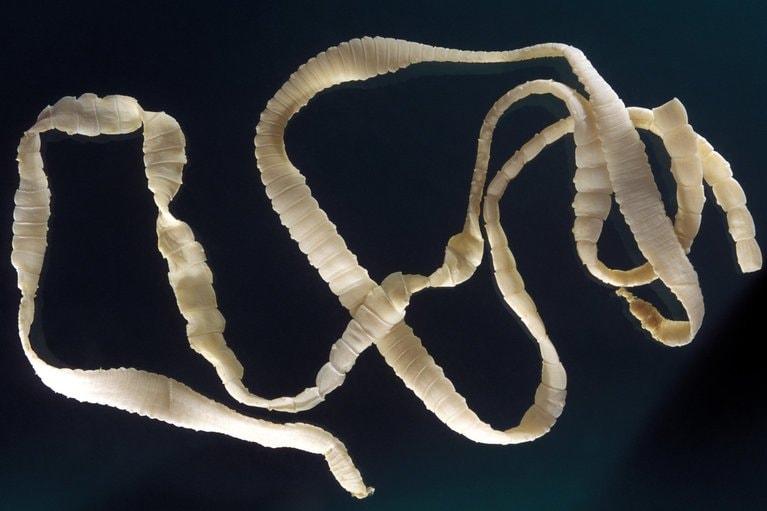
Tapeworm
Taenia spp. / Dipylidium caninum / Echinococcus spp.
Tapeworms are flat, ribbon-like segmented worms that attach to the intestinal wall using suckers and hooks. They have no digestive system and absorb nutrients directly through their skin. Adult worms shed egg-filled segments (proglottids) that look like grains of rice. Some species (Echinococcus) can form dangerous cysts in organs.

Giardia
Giardia duodenalis (syn. G. lamblia, G. intestinalis)
Giardia is a microscopic flagellated protozoan that colonizes the small intestine. It exists in two forms: the active trophozoite (pear-shaped, with two nuclei resembling a face) and the hardy cyst form that can survive in cold water for months. It is a leading cause of waterborne diarrheal illness worldwide.