
For educational purposes only. This page does not provide medical or veterinary advice, diagnosis, or treatment. Always consult a qualified healthcare or veterinary professional before making any health-related decisions.
Lice
Pediculus humanus capitis / Trichodectes canis / Felicola subrostratus
Size: Visible to naked eye — adults 2–3.5 mm; eggs (nits) approx 0.8 mm
Head lice affect 6–12 million children annually in the US alone
Lice are tiny wingless insects that live on the skin and hair of their host. They are highly host-specific — human lice cannot survive on pets and vice versa. Human head lice (Pediculus humanus capitis) are the most common, especially in school-age children. They feed on blood and lay eggs (nits) cemented to hair shafts close to the scalp.
Lifecycle
Eggs (nits) hatch in 7–10 days. Nymphs mature through three stages over 9–12 days. Adults live about 30 days on the host but die within 1–2 days off the host. Females lay 6–10 eggs per day.

Lice — Pediculus humanus capitis / Trichodectes canis / Felicola subrostratus
Symptoms
Pharmaceutical treatments
Evidence-based medications used by healthcare and veterinary professionals.
Reference only. Medication names, types, and notes are provided for general awareness. Dosage, suitability, and prescribing decisions must be made by a licensed physician or veterinarian.
Permethrin 1% (Nix)
OTCFirst-line treatment for head lice. Apply to damp hair, leave 10 minutes, rinse. Repeat in 9 days. Resistance is increasing.
Pyrethrin + piperonyl butoxide (Rid)
OTCNatural pyrethrin from chrysanthemums. Similar efficacy to permethrin. Do not use on those with ragweed allergy.
Ivermectin lotion (Sklice)
PrescriptionSingle application, no nit combing required. Highly effective including against permethrin-resistant lice.
Spinosad (Natroba)
PrescriptionHighly effective single-application treatment. Kills lice and eggs.
Fipronil / Selamectin (pets)
VeterinarySpot-on treatments effective against lice in dogs and cats. Treat all pets in the household simultaneously.
Holistic & natural approaches
Traditional, herbal, and integrative approaches for general awareness.
Not a substitute for medical treatment. Natural remedies listed here have not been evaluated by the FDA or equivalent regulatory bodies. Do not use these in place of prescribed treatment. Always consult a qualified healthcare or veterinary professional first.
Wet combing (Nit combing)
Apply conditioner to wet hair and systematically comb with a fine-toothed nit comb every 3–4 days for 2 weeks. Labor-intensive but chemical-free and effective when done thoroughly.
Tea tree oil
Terpinen-4-ol has insecticidal properties. Add 5–10 drops to shampoo or dilute in carrier oil. Some evidence of efficacy; avoid use on young children and cats (toxic to cats).
Dimethicone (silicone oil)
Physical suffocation method — coats and immobilizes lice. Available in some OTC products (Hedrin). No resistance issues. Safe for all ages.
Olive oil or coconut oil
Applied overnight under a shower cap, may suffocate lice. Must be combined with thorough nit combing. Evidence is anecdotal but widely used.
Heat treatment
Wash all bedding, clothing, and stuffed animals in hot water (60°C+) and dry on high heat. Items that cannot be washed should be sealed in a bag for 2 weeks.
Prevention
Zoonotic risk — low or none
Human lice are species-specific and cannot infect dogs or cats. Pet lice cannot infect humans. No zoonotic risk.
Related parasites

Roundworm
Ascaris lumbricoides / Toxocara spp.
Roundworms are large intestinal nematodes and among the most prevalent parasites on Earth. Adult worms live in the small intestine and can reach 15–35 cm in length. Eggs are shed in feces and can survive in soil for years. In pets, Toxocara species are the most common intestinal parasites and can occasionally infect humans (visceral larva migrans).
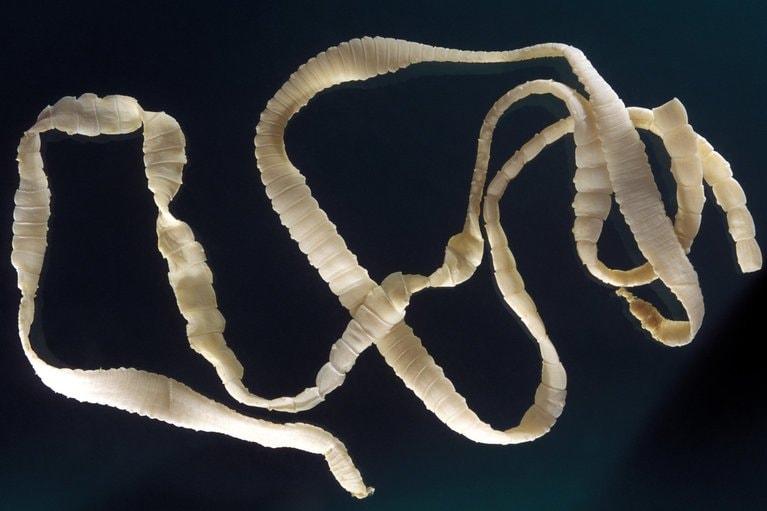
Tapeworm
Taenia spp. / Dipylidium caninum / Echinococcus spp.
Tapeworms are flat, ribbon-like segmented worms that attach to the intestinal wall using suckers and hooks. They have no digestive system and absorb nutrients directly through their skin. Adult worms shed egg-filled segments (proglottids) that look like grains of rice. Some species (Echinococcus) can form dangerous cysts in organs.

Giardia
Giardia duodenalis (syn. G. lamblia, G. intestinalis)
Giardia is a microscopic flagellated protozoan that colonizes the small intestine. It exists in two forms: the active trophozoite (pear-shaped, with two nuclei resembling a face) and the hardy cyst form that can survive in cold water for months. It is a leading cause of waterborne diarrheal illness worldwide.