
For educational purposes only. This page does not provide medical or veterinary advice, diagnosis, or treatment. Always consult a qualified healthcare or veterinary professional before making any health-related decisions.
Lungworm
Angiostrongylus vasorum / Crenosoma vulpis
Size: Visible to naked eye — adults 1–4 cm depending on species
Increasingly common in Europe, Canada, and parts of the United States; spreading to new geographic areas
Lungworm (Angiostrongylus vasorum, also called French heartworm) is a serious and potentially fatal parasite of dogs that lives in the pulmonary arteries and right side of the heart. Unlike heartworm, it is acquired by eating infected slugs, snails, or frogs — even accidentally by sniffing grass where slugs have passed. Young dogs are most at risk. Early diagnosis and treatment are critical.
Lifecycle
Dogs ingest infective larvae from slugs or snails (intermediate hosts). Larvae migrate through the gut wall to the lymph nodes, then travel via the bloodstream to the pulmonary arteries and heart. Adults mature and produce eggs that hatch into larvae, which are coughed up, swallowed, and passed in feces. Larvae are then ingested by slugs to complete the cycle.

Lungworm — Angiostrongylus vasorum / Crenosoma vulpis
Symptoms
Pharmaceutical treatments
Evidence-based medications used by healthcare and veterinary professionals.
Reference only. Medication names, types, and notes are provided for general awareness. Dosage, suitability, and prescribing decisions must be made by a licensed physician or veterinarian.
Fenbendazole
Veterinary (Prescription)Given daily for 21–28 days. Kills adult worms and larvae. Most commonly used treatment in the UK and Europe.
Milbemycin oxime (Milbemax)
Veterinary (Prescription)Monthly preventive that also treats lungworm. Effective against larvae and adults.
Moxidectin + imidacloprid (Advocate/Advantage Multi)
Veterinary (Prescription)Monthly spot-on treatment licensed for lungworm prevention and treatment in dogs.
Holistic & natural approaches
Traditional, herbal, and integrative approaches for general awareness.
Not a substitute for medical treatment. Natural remedies listed here have not been evaluated by the FDA or equivalent regulatory bodies. Do not use these in place of prescribed treatment. Always consult a qualified healthcare or veterinary professional first.
Dietary diatomaceous earth (food grade)
Some pet owners use food-grade DE as a supportive measure. Evidence is anecdotal. Not a substitute for veterinary treatment in confirmed lungworm infection.
Immune-supportive nutrition
High-quality protein and omega-3 fatty acids may support recovery. Discuss with a veterinarian before making dietary changes during treatment.
Prevention
Zoonotic risk — low or none
Angiostrongylus vasorum does not infect humans. A related species, Angiostrongylus cantonensis (rat lungworm), can cause eosinophilic meningitis in humans but is a distinct parasite with a different lifecycle.
Related parasites

Roundworm
Ascaris lumbricoides / Toxocara spp.
Roundworms are large intestinal nematodes and among the most prevalent parasites on Earth. Adult worms live in the small intestine and can reach 15–35 cm in length. Eggs are shed in feces and can survive in soil for years. In pets, Toxocara species are the most common intestinal parasites and can occasionally infect humans (visceral larva migrans).
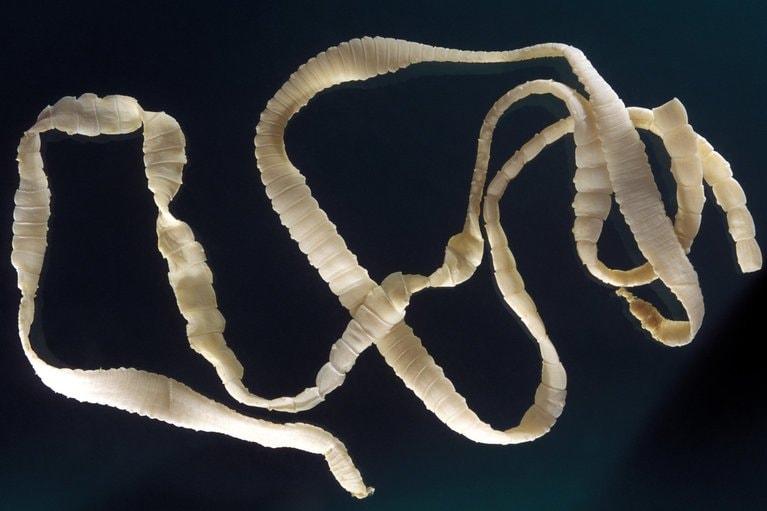
Tapeworm
Taenia spp. / Dipylidium caninum / Echinococcus spp.
Tapeworms are flat, ribbon-like segmented worms that attach to the intestinal wall using suckers and hooks. They have no digestive system and absorb nutrients directly through their skin. Adult worms shed egg-filled segments (proglottids) that look like grains of rice. Some species (Echinococcus) can form dangerous cysts in organs.

Giardia
Giardia duodenalis (syn. G. lamblia, G. intestinalis)
Giardia is a microscopic flagellated protozoan that colonizes the small intestine. It exists in two forms: the active trophozoite (pear-shaped, with two nuclei resembling a face) and the hardy cyst form that can survive in cold water for months. It is a leading cause of waterborne diarrheal illness worldwide.