
For educational purposes only. This page does not provide medical or veterinary advice, diagnosis, or treatment. Always consult a qualified healthcare or veterinary professional before making any health-related decisions.
Pinworm
Enterobius vermicularis
Size: Visible to naked eye — adults 2–13 mm; females up to 13 mm
Most common intestinal worm infection in the US — estimated 1 billion infections worldwide, especially in children aged 5–10
Pinworms are small, thin white worms about the size of a staple that infect the large intestine and rectum. They are the most common worm infection in the United States and are highly contagious, spreading easily among children in schools and households. The infection is rarely serious but causes intense anal itching, particularly at night when female worms migrate to the perianal area to lay eggs.
Lifecycle
Eggs are ingested from contaminated hands, surfaces, or bedding. Larvae hatch in the small intestine and migrate to the large intestine where they mature into adults. Female worms migrate to the perianal area at night to deposit thousands of eggs. Eggs become infectious within hours and can survive on surfaces for up to 3 weeks. Reinfection through hand-to-mouth contact is extremely common.
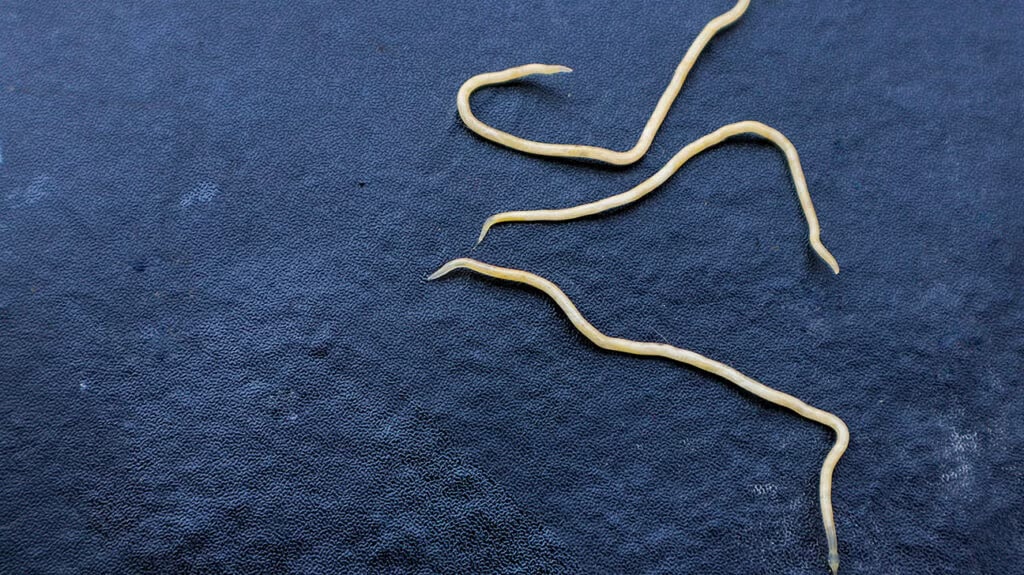
Pinworm — Enterobius vermicularis
Symptoms
Pharmaceutical treatments
Evidence-based medications used by healthcare and veterinary professionals.
Reference only. Medication names, types, and notes are provided for general awareness. Dosage, suitability, and prescribing decisions must be made by a licensed physician or veterinarian.
Mebendazole (Emverm)
PrescriptionFirst-line treatment. Kills adult worms by blocking glucose uptake. A second dose 2 weeks later eliminates newly hatched worms. Treat all household members simultaneously to prevent reinfection.
Albendazole (Albenza)
PrescriptionHighly effective alternative to mebendazole. Same mechanism of action. Repeat dosing in 2 weeks is essential. Treat entire household at the same time.
Pyrantel pamoate (Pin-X, Reese's Pinworm Medicine)
OTCOver-the-counter option available without a prescription. Paralyzes worms so they can be expelled. Less effective than mebendazole but widely accessible. Repeat dose in 2 weeks is critical.
Holistic & natural approaches
Traditional, herbal, and integrative approaches for general awareness.
Not a substitute for medical treatment. Natural remedies listed here have not been evaluated by the FDA or equivalent regulatory bodies. Do not use these in place of prescribed treatment. Always consult a qualified healthcare or veterinary professional first.
Raw garlic
Allicin in garlic has demonstrated antiparasitic properties in laboratory studies. Consume 1–2 raw cloves daily or apply a small amount of garlic paste to the perianal area. Limited clinical evidence but widely used in traditional medicine. Not a substitute for pharmaceutical treatment.
Coconut oil
Lauric acid in coconut oil may have antiparasitic properties. Apply topically to the perianal area to soothe itching and potentially reduce egg survival. Can be consumed (1–3 tablespoons daily) as a complementary approach. Evidence is anecdotal.
Pumpkin seeds
Cucurbitacin in pumpkin seeds may paralyze worms. Consume 1–2 oz of raw seeds on an empty stomach. Traditional remedy with limited clinical evidence. Best used as a complement to proven pharmaceutical treatment.
Strict hygiene protocol
Rigorous hygiene is the most evidence-based non-pharmaceutical intervention. Wash hands thoroughly after using the toilet and before meals. Shower every morning to remove eggs deposited overnight. Wash bedding, pajamas, and underwear in hot water daily during treatment. Cut fingernails short.
Prevention
Zoonotic risk — low or none
Pinworms (Enterobius vermicularis) are strictly a human parasite and cannot infect dogs, cats, or other animals. Pets do not carry or transmit human pinworms. Some animals have their own species of pinworms (e.g. Oxyuris equi in horses) but these cannot infect humans.
Related parasites

Roundworm
Ascaris lumbricoides / Toxocara spp.
Roundworms are large intestinal nematodes and among the most prevalent parasites on Earth. Adult worms live in the small intestine and can reach 15–35 cm in length. Eggs are shed in feces and can survive in soil for years. In pets, Toxocara species are the most common intestinal parasites and can occasionally infect humans (visceral larva migrans).
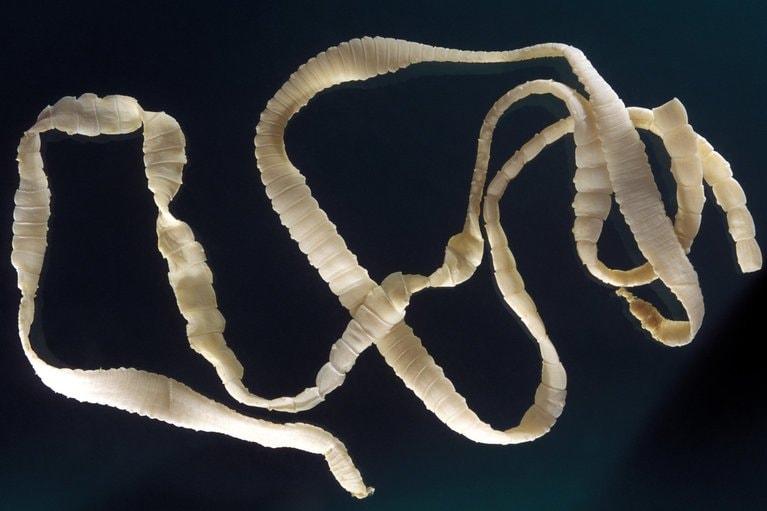
Tapeworm
Taenia spp. / Dipylidium caninum / Echinococcus spp.
Tapeworms are flat, ribbon-like segmented worms that attach to the intestinal wall using suckers and hooks. They have no digestive system and absorb nutrients directly through their skin. Adult worms shed egg-filled segments (proglottids) that look like grains of rice. Some species (Echinococcus) can form dangerous cysts in organs.

Giardia
Giardia duodenalis (syn. G. lamblia, G. intestinalis)
Giardia is a microscopic flagellated protozoan that colonizes the small intestine. It exists in two forms: the active trophozoite (pear-shaped, with two nuclei resembling a face) and the hardy cyst form that can survive in cold water for months. It is a leading cause of waterborne diarrheal illness worldwide.