
For educational purposes only. This page does not provide medical or veterinary advice, diagnosis, or treatment. Always consult a qualified healthcare or veterinary professional before making any health-related decisions.
Scabies / Mange
Sarcoptes scabiei var. hominis / var. canis
Size: Microscopic — adults 0.3–0.4 mm; barely visible as tiny dots
~200 million people affected worldwide at any given time; highly endemic in resource-limited settings
Scabies is caused by microscopic burrowing mites that tunnel into the outer layer of skin (stratum corneum) to lay eggs. The intense itching is an allergic reaction to the mites, their eggs, and feces. In dogs, the same genus causes sarcoptic mange — a severe, highly contagious skin disease. Human and dog strains can cross-infect but do not establish permanent infestations in the non-primary host.
Lifecycle
Mated female mites burrow into skin and lay 2–3 eggs per day for 1–2 months. Eggs hatch in 3–4 days. Larvae migrate to skin surface, mature through nymph stages, and mate. The entire lifecycle takes 10–17 days. Mites can survive off the host for 24–36 hours.

Scabies / Mange — Sarcoptes scabiei var. hominis / var. canis
Symptoms
Pharmaceutical treatments
Evidence-based medications used by healthcare and veterinary professionals.
Reference only. Medication names, types, and notes are provided for general awareness. Dosage, suitability, and prescribing decisions must be made by a licensed physician or veterinarian.
Permethrin 5% cream (Elimite)
PrescriptionFirst-line treatment. Apply from neck to toes, leave 8–14 hours, wash off. Repeat in 1 week. Safe in pregnancy and for children over 2 months.
Oral ivermectin
Prescription200 mcg/kg single dose, repeated in 2 weeks. Preferred for crusted scabies and institutional outbreaks. Not for children under 15 kg or pregnant women.
Crotamiton (Eurax)
PrescriptionAlternative topical treatment. Apply for 2 consecutive nights. Less effective than permethrin.
Lime sulfur dip (dogs)
VeterinaryWeekly dips for 4–6 weeks. Highly effective but has strong odor. Stains surfaces.
Selamectin / Ivermectin (dogs)
VeterinaryRevolution (selamectin) or injectable ivermectin for dogs. Treat all dogs in the household.
Holistic & natural approaches
Traditional, herbal, and integrative approaches for general awareness.
Not a substitute for medical treatment. Natural remedies listed here have not been evaluated by the FDA or equivalent regulatory bodies. Do not use these in place of prescribed treatment. Always consult a qualified healthcare or veterinary professional first.
Tea tree oil
5% tea tree oil has shown efficacy against scabies mites in laboratory studies. Dilute in carrier oil and apply to affected areas. A small clinical trial showed comparable efficacy to permethrin for symptom relief.
Neem oil
Azadirachtin in neem disrupts mite reproduction. Apply neem oil mixed with turmeric paste to affected skin. Used extensively in Ayurvedic medicine for skin parasites.
Clove oil
Eugenol has demonstrated acaricidal (mite-killing) activity in studies. Dilute 1:10 in carrier oil. Apply to affected areas twice daily.
Aloe vera
Soothes itching and inflammation. A small study found aloe vera gel comparable to benzyl benzoate for scabies treatment. Apply pure gel to affected areas.
Environmental decontamination
Wash all clothing, bedding, and towels in hot water (60°C+) and dry on high heat. Items that cannot be washed should be sealed in plastic bags for 72 hours. Vacuum all furniture and carpets.
Prevention
Zoonotic risk — can spread between animals and humans
Dog scabies (sarcoptic mange) can temporarily infect humans, causing an itchy rash. Human infestation from dogs is self-limiting (mites cannot complete their lifecycle on humans) but requires treating the dog to stop reinfection.
Related parasites

Roundworm
Ascaris lumbricoides / Toxocara spp.
Roundworms are large intestinal nematodes and among the most prevalent parasites on Earth. Adult worms live in the small intestine and can reach 15–35 cm in length. Eggs are shed in feces and can survive in soil for years. In pets, Toxocara species are the most common intestinal parasites and can occasionally infect humans (visceral larva migrans).
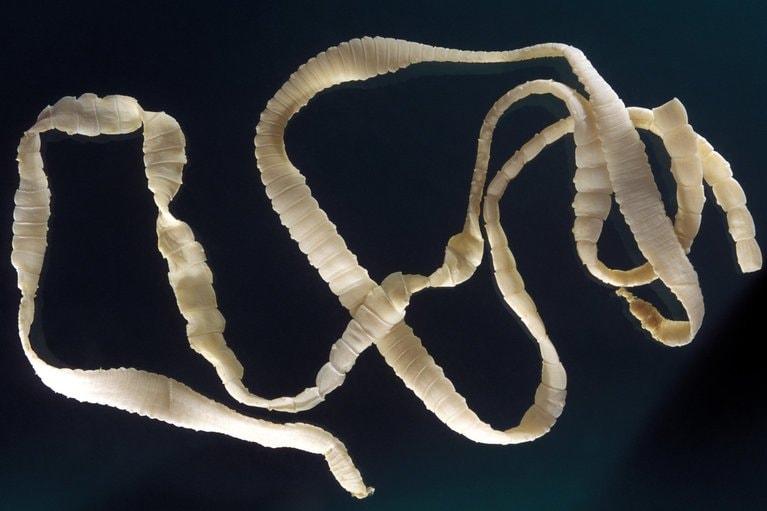
Tapeworm
Taenia spp. / Dipylidium caninum / Echinococcus spp.
Tapeworms are flat, ribbon-like segmented worms that attach to the intestinal wall using suckers and hooks. They have no digestive system and absorb nutrients directly through their skin. Adult worms shed egg-filled segments (proglottids) that look like grains of rice. Some species (Echinococcus) can form dangerous cysts in organs.

Giardia
Giardia duodenalis (syn. G. lamblia, G. intestinalis)
Giardia is a microscopic flagellated protozoan that colonizes the small intestine. It exists in two forms: the active trophozoite (pear-shaped, with two nuclei resembling a face) and the hardy cyst form that can survive in cold water for months. It is a leading cause of waterborne diarrheal illness worldwide.