
For educational purposes only. This page does not provide medical or veterinary advice, diagnosis, or treatment. Always consult a qualified healthcare or veterinary professional before making any health-related decisions.
Strongyloides
Strongyloides stercoralis
Size: Microscopic to barely visible — adults 2–2.5 mm; larvae 200–500 µm
Estimated 30–100 million people infected worldwide; endemic in tropical and subtropical regions
Strongyloides stercoralis is a unique intestinal nematode capable of autoinfection — larvae can re-infect the same host without leaving the body, allowing infection to persist for decades. In immunocompromised individuals, this can lead to hyperinfection syndrome, a life-threatening condition where massive numbers of larvae disseminate throughout the body. Dogs are also susceptible to a related species (S. stercoralis or S. canis).
Lifecycle
Infective filariform larvae penetrate skin from contaminated soil. They migrate through the bloodstream to the lungs, are coughed up and swallowed, and mature in the small intestine. Females reproduce parthenogenetically. Rhabditiform larvae passed in feces can develop into infective larvae in the environment — or autoinfect the same host by penetrating the intestinal wall or perianal skin.

Strongyloides — Strongyloides stercoralis
Symptoms
Pharmaceutical treatments
Evidence-based medications used by healthcare and veterinary professionals.
Reference only. Medication names, types, and notes are provided for general awareness. Dosage, suitability, and prescribing decisions must be made by a licensed physician or veterinarian.
Ivermectin
PrescriptionDrug of choice for strongyloidiasis. Two doses 2 weeks apart for uncomplicated infection. Daily dosing for hyperinfection syndrome until larvae are undetectable.
Albendazole
PrescriptionAlternative when ivermectin is unavailable. 400 mg twice daily for 7 days. Less effective than ivermectin.
Thiabendazole
PrescriptionOlder treatment option, now rarely used due to side effects. Still used in some veterinary protocols.
Holistic & natural approaches
Traditional, herbal, and integrative approaches for general awareness.
Not a substitute for medical treatment. Natural remedies listed here have not been evaluated by the FDA or equivalent regulatory bodies. Do not use these in place of prescribed treatment. Always consult a qualified healthcare or veterinary professional first.
Papaya seed extract
Carpaine and benzyl isothiocyanate in papaya seeds have shown antiparasitic activity in some studies. Used traditionally in endemic regions as a supportive measure.
Wormwood (Artemisia absinthium)
Traditional antiparasitic herb used in many cultures. Some evidence of activity against intestinal nematodes. Use with caution — toxic in high doses.
Probiotic support
Restoring gut flora after treatment may help prevent reinfection and support intestinal recovery. Lactobacillus and Bifidobacterium strains are commonly used.
Prevention
Zoonotic risk — can spread between animals and humans
Strongyloides stercoralis can infect both humans and dogs. While human-to-dog and dog-to-human transmission is considered uncommon, shared environmental contamination is a risk. Infected dogs should be treated and their environment decontaminated.
Related parasites

Roundworm
Ascaris lumbricoides / Toxocara spp.
Roundworms are large intestinal nematodes and among the most prevalent parasites on Earth. Adult worms live in the small intestine and can reach 15–35 cm in length. Eggs are shed in feces and can survive in soil for years. In pets, Toxocara species are the most common intestinal parasites and can occasionally infect humans (visceral larva migrans).
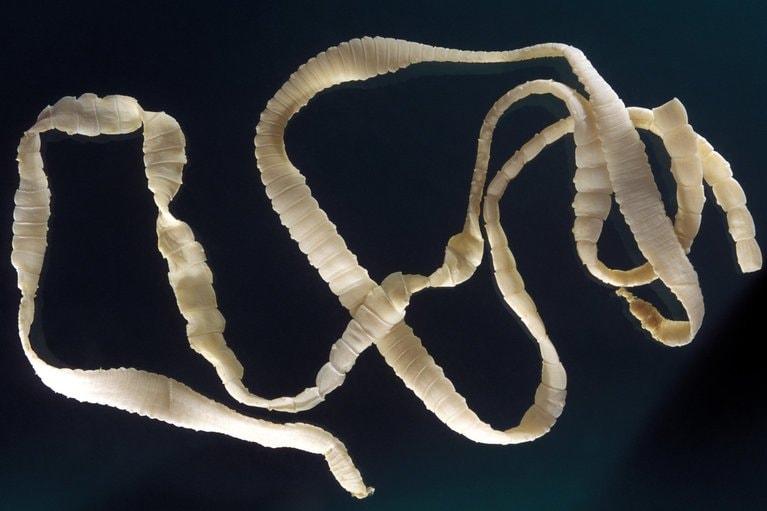
Tapeworm
Taenia spp. / Dipylidium caninum / Echinococcus spp.
Tapeworms are flat, ribbon-like segmented worms that attach to the intestinal wall using suckers and hooks. They have no digestive system and absorb nutrients directly through their skin. Adult worms shed egg-filled segments (proglottids) that look like grains of rice. Some species (Echinococcus) can form dangerous cysts in organs.

Giardia
Giardia duodenalis (syn. G. lamblia, G. intestinalis)
Giardia is a microscopic flagellated protozoan that colonizes the small intestine. It exists in two forms: the active trophozoite (pear-shaped, with two nuclei resembling a face) and the hardy cyst form that can survive in cold water for months. It is a leading cause of waterborne diarrheal illness worldwide.