
For educational purposes only. This page does not provide medical or veterinary advice, diagnosis, or treatment. Always consult a qualified healthcare or veterinary professional before making any health-related decisions.
Tick
Ixodes scapularis / Dermacentor variabilis / Amblyomma americanum
Size: Visible to naked eye — unfed 1–5 mm; engorged up to 15 mm
Lyme disease (tick-borne) is the most common vector-borne disease in the US — ~476,000 cases diagnosed annually
Ticks are blood-feeding arachnids (related to spiders and mites) that are important vectors of numerous serious diseases. They cannot jump or fly — they 'quest' by holding onto vegetation with their back legs and reaching out with their front legs to grab passing hosts. Hard ticks (Ixodidae) feed for days; soft ticks (Argasidae) feed quickly.
Lifecycle
Ticks have four life stages: egg, larva (6 legs), nymph (8 legs), and adult. Each active stage requires a blood meal. The full lifecycle takes 2–3 years. Nymphs are the most dangerous stage for disease transmission — they are tiny (poppy seed-sized) and often go unnoticed.

Tick — Ixodes scapularis / Dermacentor variabilis / Amblyomma americanum
Symptoms
Pharmaceutical treatments
Evidence-based medications used by healthcare and veterinary professionals.
Reference only. Medication names, types, and notes are provided for general awareness. Dosage, suitability, and prescribing decisions must be made by a licensed physician or veterinarian.
Doxycycline
PrescriptionFirst-line antibiotic for Lyme disease, Rocky Mountain spotted fever, ehrlichiosis, and anaplasmosis. 100 mg twice daily for 10–21 days.
Amoxicillin / Cefuroxime
PrescriptionAlternative to doxycycline for Lyme disease in pregnant women and young children.
Fluralaner (Bravecto)
PrescriptionHighly effective tick prevention for dogs and cats. Single dose lasts 3 months.
Afoxolaner (NexGard)
PrescriptionMonthly oral tick and flea prevention for dogs.
Seresto collar
OTCImidacloprid + flumethrin collar. Provides 8 months of tick and flea protection for dogs and cats.
Holistic & natural approaches
Traditional, herbal, and integrative approaches for general awareness.
Not a substitute for medical treatment. Natural remedies listed here have not been evaluated by the FDA or equivalent regulatory bodies. Do not use these in place of prescribed treatment. Always consult a qualified healthcare or veterinary professional first.
Prompt tick removal
The single most important intervention. Use fine-tipped tweezers, grasp as close to the skin as possible, pull straight up with steady pressure. Clean the bite with alcohol. Lyme transmission requires 36–48 hours of attachment.
DEET repellent (humans)
20–30% DEET is highly effective at repelling ticks. Apply to exposed skin and clothing. Permethrin-treated clothing provides additional protection.
Rose geranium oil
Pelargonium graveolens oil is used as a natural tick repellent for dogs. Apply a drop to the collar. Do not use on cats (toxic to felines).
Protective clothing
Wear long sleeves and pants, tuck pants into socks in tick-infested areas. Light-colored clothing makes ticks easier to spot. Shower within 2 hours of outdoor activity.
Yard management
Keep grass short, remove leaf litter, create a wood chip barrier between lawn and wooded areas. Deer fencing reduces tick populations significantly.
Prevention
Zoonotic risk — can spread between animals and humans
Ticks are vectors for Lyme disease, Rocky Mountain spotted fever, ehrlichiosis, anaplasmosis, babesiosis, tularemia, and tick-borne encephalitis. Pets can carry ticks into the home, increasing human exposure risk.
Related parasites

Roundworm
Ascaris lumbricoides / Toxocara spp.
Roundworms are large intestinal nematodes and among the most prevalent parasites on Earth. Adult worms live in the small intestine and can reach 15–35 cm in length. Eggs are shed in feces and can survive in soil for years. In pets, Toxocara species are the most common intestinal parasites and can occasionally infect humans (visceral larva migrans).
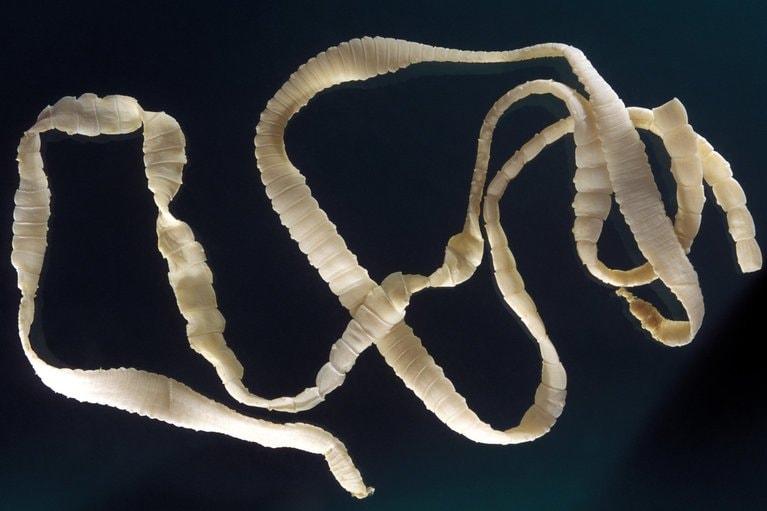
Tapeworm
Taenia spp. / Dipylidium caninum / Echinococcus spp.
Tapeworms are flat, ribbon-like segmented worms that attach to the intestinal wall using suckers and hooks. They have no digestive system and absorb nutrients directly through their skin. Adult worms shed egg-filled segments (proglottids) that look like grains of rice. Some species (Echinococcus) can form dangerous cysts in organs.

Giardia
Giardia duodenalis (syn. G. lamblia, G. intestinalis)
Giardia is a microscopic flagellated protozoan that colonizes the small intestine. It exists in two forms: the active trophozoite (pear-shaped, with two nuclei resembling a face) and the hardy cyst form that can survive in cold water for months. It is a leading cause of waterborne diarrheal illness worldwide.