
For educational purposes only. This page does not provide medical or veterinary advice, diagnosis, or treatment. Always consult a qualified healthcare or veterinary professional before making any health-related decisions.
Toxoplasma
Toxoplasma gondii
Size: Microscopic — oocysts 10–12 µm; tissue cysts up to 200 µm
Estimated to infect 25–30% of the global human population; up to 40% in some countries
Toxoplasma gondii is an obligate intracellular parasite that can infect virtually any warm-blooded animal. Cats are the only definitive host where the parasite reproduces sexually. In most healthy humans, infection causes no symptoms. However, it poses serious risks to pregnant women (congenital toxoplasmosis) and immunocompromised individuals.
Lifecycle
Cats shed oocysts in feces after eating infected prey. Oocysts sporulate in the environment and can be ingested by intermediate hosts (humans, livestock, rodents). In intermediate hosts, the parasite forms tissue cysts in muscles and brain that persist for life.

Toxoplasma — Toxoplasma gondii
Symptoms
Pharmaceutical treatments
Evidence-based medications used by healthcare and veterinary professionals.
Reference only. Medication names, types, and notes are provided for general awareness. Dosage, suitability, and prescribing decisions must be made by a licensed physician or veterinarian.
Pyrimethamine + Sulfadiazine
PrescriptionStandard treatment for severe/symptomatic toxoplasmosis. Combined with folinic acid to prevent bone marrow suppression.
Spiramycin
PrescriptionUsed in pregnancy to prevent mother-to-child transmission. Does not cross the placenta well, so does not treat fetal infection.
Trimethoprim-sulfamethoxazole
PrescriptionAlternative for patients who cannot tolerate standard therapy.
Clindamycin
PrescriptionUsed for ocular toxoplasmosis and as an alternative in combination regimens.
Holistic & natural approaches
Traditional, herbal, and integrative approaches for general awareness.
Not a substitute for medical treatment. Natural remedies listed here have not been evaluated by the FDA or equivalent regulatory bodies. Do not use these in place of prescribed treatment. Always consult a qualified healthcare or veterinary professional first.
Artemisinin (Sweet wormwood)
Artemisia annua extracts have shown activity against T. gondii in laboratory studies. Used in integrative oncology and antiparasitic protocols.
Curcumin (Turmeric)
Anti-inflammatory and immunomodulatory properties. Some studies show curcumin inhibits T. gondii replication in vitro. Supports immune response.
Immune support
Vitamin C, zinc, and selenium support immune function to keep latent infection in check. A healthy immune system prevents reactivation.
Dietary precautions
Cook all meat thoroughly. Freeze meat at -20°C for 24 hours before eating to kill tissue cysts. Avoid raw or undercooked meat entirely.
Prevention
Zoonotic risk — can spread between animals and humans
Cats are the primary source of environmental contamination. However, eating undercooked meat is the most common route of human infection. Congenital transmission from mother to fetus is the most serious concern.
Related parasites

Roundworm
Ascaris lumbricoides / Toxocara spp.
Roundworms are large intestinal nematodes and among the most prevalent parasites on Earth. Adult worms live in the small intestine and can reach 15–35 cm in length. Eggs are shed in feces and can survive in soil for years. In pets, Toxocara species are the most common intestinal parasites and can occasionally infect humans (visceral larva migrans).
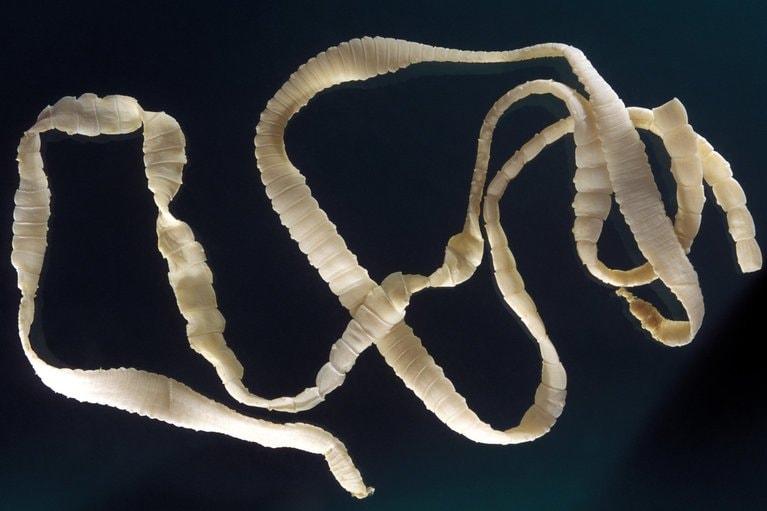
Tapeworm
Taenia spp. / Dipylidium caninum / Echinococcus spp.
Tapeworms are flat, ribbon-like segmented worms that attach to the intestinal wall using suckers and hooks. They have no digestive system and absorb nutrients directly through their skin. Adult worms shed egg-filled segments (proglottids) that look like grains of rice. Some species (Echinococcus) can form dangerous cysts in organs.

Giardia
Giardia duodenalis (syn. G. lamblia, G. intestinalis)
Giardia is a microscopic flagellated protozoan that colonizes the small intestine. It exists in two forms: the active trophozoite (pear-shaped, with two nuclei resembling a face) and the hardy cyst form that can survive in cold water for months. It is a leading cause of waterborne diarrheal illness worldwide.