
For educational purposes only. This page does not provide medical or veterinary advice, diagnosis, or treatment. Always consult a qualified healthcare or veterinary professional before making any health-related decisions.
Whipworm
Trichuris trichiura / Trichuris vulpis
Size: Visible to naked eye — adults 3–5 cm
~600–800 million people infected globally; one of the most common soil-transmitted helminths
Whipworms are named for their distinctive shape — thin at the front (like a whip handle) and thicker at the rear. The thin end embeds into the intestinal wall, causing inflammation and bleeding. Eggs are extremely hardy and can survive in soil for years. Dogs are commonly infected with Trichuris vulpis, which does not infect humans.
Lifecycle
Eggs are ingested from contaminated soil or food. Larvae hatch in the small intestine and migrate to the cecum (junction of small and large intestine) where they mature over 3 months. Adults can live 1–3 years. Females produce 2,000–10,000 eggs per day.

Whipworm — Trichuris trichiura / Trichuris vulpis
Symptoms
Pharmaceutical treatments
Evidence-based medications used by healthcare and veterinary professionals.
Reference only. Medication names, types, and notes are provided for general awareness. Dosage, suitability, and prescribing decisions must be made by a licensed physician or veterinarian.
Mebendazole
OTC/Prescription100 mg twice daily for 3 days. First-line treatment for human whipworm. May need repeat courses.
Albendazole
Prescription400 mg daily for 3 days. Alternative to mebendazole.
Ivermectin + albendazole
PrescriptionCombination therapy for heavy or resistant infections. More effective than single agents.
Fenbendazole (dogs)
Veterinary50 mg/kg daily for 3 days, repeated at 3 weeks and 3 months. Whipworm eggs persist in soil, so reinfection is common.
Febantel/Praziquantel/Pyrantel (Drontal Plus)
VeterinaryCombination dewormer for dogs covering whipworms, tapeworms, and roundworms.
Holistic & natural approaches
Traditional, herbal, and integrative approaches for general awareness.
Not a substitute for medical treatment. Natural remedies listed here have not been evaluated by the FDA or equivalent regulatory bodies. Do not use these in place of prescribed treatment. Always consult a qualified healthcare or veterinary professional first.
Papaya seeds
Contain benzyl isothiocyanate with anthelmintic properties. Blend 1 tablespoon of seeds with honey and take on an empty stomach for 7 days. Some clinical evidence supports efficacy against intestinal helminths.
Wormwood (Artemisia absinthium)
Traditional anthelmintic herb. Thujone and absinthin have antiparasitic properties. Available as tea or tincture. Use short-term only — thujone is neurotoxic in high doses.
Black walnut hull tincture
Juglone has demonstrated activity against intestinal parasites. Part of traditional antiparasitic protocols. Use as directed on product label.
High-fiber diet
Adequate dietary fiber supports gut motility and reduces transit time, limiting the worm's ability to establish. Increase vegetables, legumes, and whole grains.
Soil hygiene
Whipworm eggs survive in soil for years. Concrete runs for dogs, prompt fecal removal, and avoiding bare soil contact are the most effective environmental controls.
Prevention
Zoonotic risk — low or none
Trichuris vulpis (dog whipworm) does not infect humans. Human whipworm (T. trichiura) is spread person-to-person through contaminated soil, not from dogs.
Related parasites

Roundworm
Ascaris lumbricoides / Toxocara spp.
Roundworms are large intestinal nematodes and among the most prevalent parasites on Earth. Adult worms live in the small intestine and can reach 15–35 cm in length. Eggs are shed in feces and can survive in soil for years. In pets, Toxocara species are the most common intestinal parasites and can occasionally infect humans (visceral larva migrans).
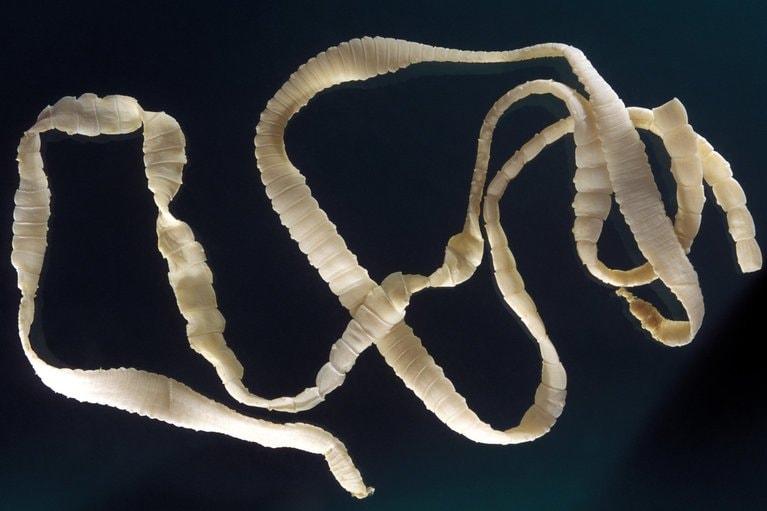
Tapeworm
Taenia spp. / Dipylidium caninum / Echinococcus spp.
Tapeworms are flat, ribbon-like segmented worms that attach to the intestinal wall using suckers and hooks. They have no digestive system and absorb nutrients directly through their skin. Adult worms shed egg-filled segments (proglottids) that look like grains of rice. Some species (Echinococcus) can form dangerous cysts in organs.

Giardia
Giardia duodenalis (syn. G. lamblia, G. intestinalis)
Giardia is a microscopic flagellated protozoan that colonizes the small intestine. It exists in two forms: the active trophozoite (pear-shaped, with two nuclei resembling a face) and the hardy cyst form that can survive in cold water for months. It is a leading cause of waterborne diarrheal illness worldwide.