
For educational purposes only. This page does not provide medical or veterinary advice, diagnosis, or treatment. Always consult a qualified healthcare or veterinary professional before making any health-related decisions.
Pennella
Pennella spp.
Size: Visible to naked eye — adults 10–32 cm; one of the largest known parasitic copepods
Found worldwide in tropical and temperate oceans; common on large pelagic fish (swordfish, marlin, tuna) and marine mammals; well-known to commercial fishermen and marine biologists
Pennella are large parasitic copepods (crustaceans) that embed deeply into the flesh of large marine fish and marine mammals. Unlike most copepods, Pennella burrow their anterior (head) end into the host's muscle or blubber, leaving a long, feathery egg-bearing tail dangling externally — sometimes reaching 30 cm in length. They are among the largest known parasitic copepods. While visually dramatic, single parasites rarely cause serious harm to large hosts. Heavy infestations can cause significant tissue damage, inflammation, and secondary infections. They are commonly seen on swordfish, marlin, and whales.
Lifecycle
Free-swimming nauplii larvae hatch from egg strings and go through several larval stages before attaching to a host. The female burrows her head end into the host's skin and muscle, anchoring herself permanently. She then grows a long external body bearing paired egg strings. Males are tiny and short-lived. Larvae released from the egg strings enter the water column to find new hosts.
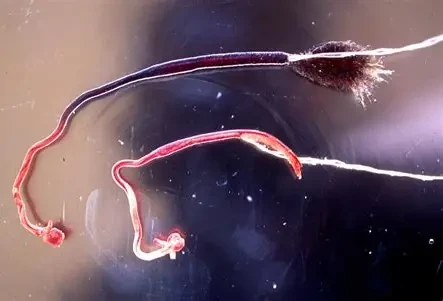
Pennella — Pennella spp.
Symptoms
Pharmaceutical treatments
Evidence-based medications used by healthcare and veterinary professionals.
Reference only. Medication names, types, and notes are provided for general awareness. Dosage, suitability, and prescribing decisions must be made by a licensed physician or veterinarian.
Manual removal (aquaculture/aquarium)
Physical procedurePennella can be carefully removed with forceps by grasping close to the skin and pulling steadily. The embedded head must be fully removed to prevent infection. Wound treatment with antiseptic is recommended after removal.
Antibiotic wound treatment
Veterinary prescriptionSecondary bacterial infections at attachment sites may require antibiotic treatment in aquaculture settings. Used after physical removal of the parasite.
Holistic & natural approaches
Traditional, herbal, and integrative approaches for general awareness.
Not a substitute for medical treatment. Natural remedies listed here have not been evaluated by the FDA or equivalent regulatory bodies. Do not use these in place of prescribed treatment. Always consult a qualified healthcare or veterinary professional first.
Cleaner fish (biological control)
In aquarium settings, cleaner wrasses may pick at and remove small Pennella. In the wild, cleaning stations on reefs serve a similar function for fish that visit them.
Quarantine and inspection
New large fish added to aquariums should be carefully inspected for Pennella before introduction. The parasites are large enough to be visible to the naked eye.
Prevention
Zoonotic risk — low or none
Pennella does not infect humans. It is exclusively a parasite of marine fish and marine mammals. Fish with Pennella are safe to eat after proper processing.
Related parasites
Anisakis
Anisakis simplex
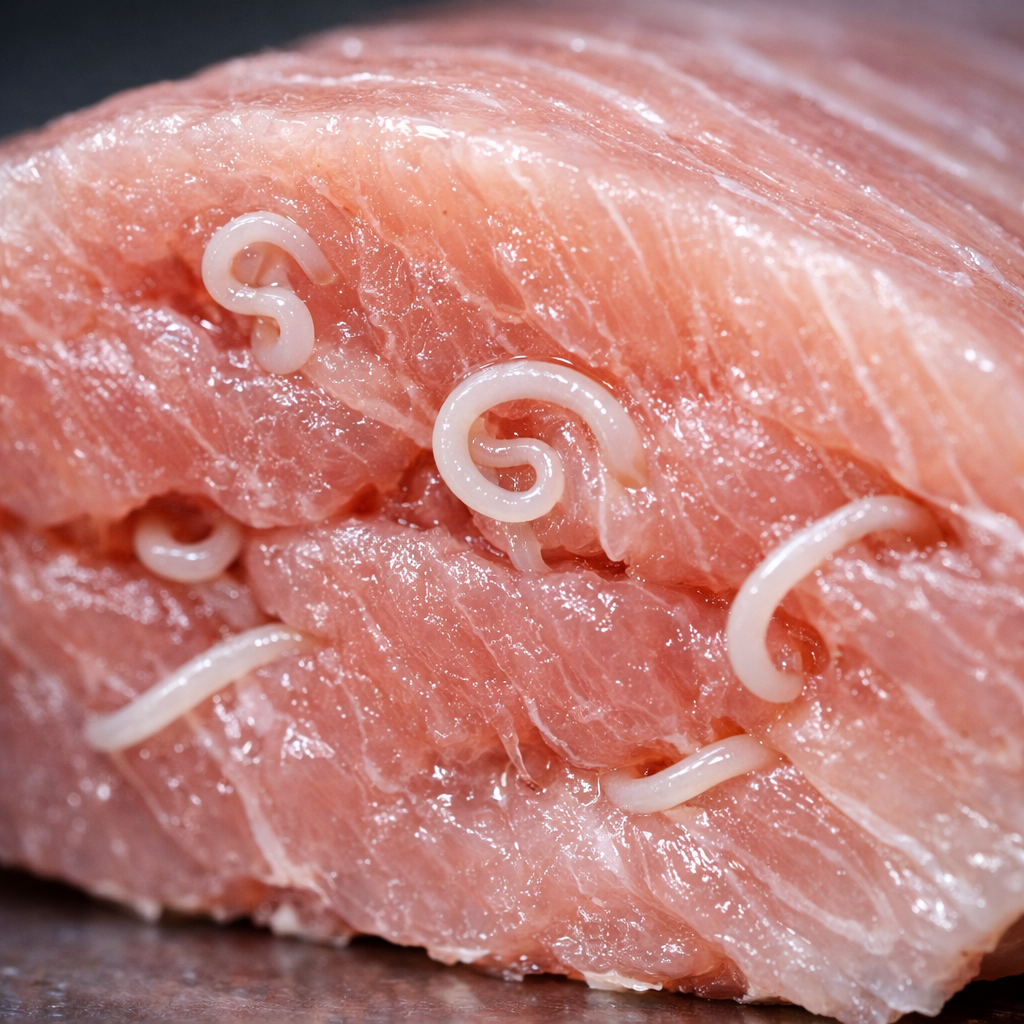
Anisakis is a parasitic nematode (roundworm) found in the flesh of many marine fish and squid. Humans become accidental hosts by eating raw or undercooked seafood — sushi, sashimi, ceviche, and lightly cured fish are common sources. The larvae cannot complete their lifecycle in humans but burrow into the stomach or intestinal wall, causing a painful condition called anisakiasis. Marine mammals such as dolphins and seals are the definitive hosts.

Tongue-Eating Louse
Cymothoa exigua
Cymothoa exigua is one of the most remarkable parasites known to science — the only parasite known to functionally replace a host organ. This marine isopod (a crustacean related to pill bugs) enters a fish through the gills as a juvenile male, attaches to the tongue, severs its blood supply, and causes the tongue to atrophy. The parasite then takes the tongue's place, functioning as a replacement tongue while feeding on the fish's blood and mucus. The fish can still eat with the parasite in place. It poses no known risk to humans.

Sea Lice
Lepeophtheirus salmonis / Caligus spp.
Sea lice are parasitic copepods (tiny crustaceans) that attach to the skin, scales, and mucus of marine fish, particularly salmon. They are one of the most economically damaging parasites in the global aquaculture industry. Sea lice feed on skin, mucus, and blood, causing lesions, stress, and secondary infections. Heavy infestations can be fatal. Salmon farms create dense fish populations that allow sea lice to multiply rapidly and spread to wild salmon populations nearby — a major environmental controversy.